A TREATISE ON THE PROJECTED IMAGE: RIFAT CHADIRJI AND “THE GEOMETRY OF HUMAN INDUSTRY”
“In the difficult hour we are living, what else can we desire than to exclude nothing and to learn how to braid with white thread and black thread a single cord stretched to the breaking-point?” (150)
– Return to Tipasa, Albert Camus
In the porous secretion of an image-maker’s archive, a gesture of finality is poised that questions the imminent return of what was once experienced. Like a cloud-smoked mirror that from time has burnished to a black tar, the ‘decipherable traces’ remain as Foucault suggests. Iraqi architect Rifat Chadirji (b.1926) has been situated amongst the lucid men of his time. Yet, extending beyond a regional index, the personal gaze that so prevailed over his land has been decipherably left unread. Earlier collaterals, such as Building Index (Edited by Akram Zaatari and Mark Wasiuta, co-published by Kaph Books and the Arab Image Foundation), and the exhibition at Columbia University: Every Building in Baghdad: The Rifat Chadirji Archives at the Arab Image Foundation (2018), prioritized the surveillance of architecture as the primary access point to the mindscape of Chadirji. In a peripheral mode of investigation, I argue that Chadirji’s fundamental mode of recognition was not dependent on the architectural regime, but on his photographic consolidation of a country’s well-spring of social affect, representations of labor and trade, and the visual latitudes of reconstruction and deconstruction; the assembly and disassembly of a genealogy of belonging as tied to the receptiveness of the altered and lived-in land.
Chadirji’s photographs become the entry to a breaking point, a way to learn how to “braid with white thread and black thread a single cord.” Perhaps this desire for singularity will be extinguished in time, but it still persists as one of the magnum opus dedications of an architect to his birthplace, and the pervasive concept of what Camus deciphers in The Myth of Sissyphus as “...the wholly human security of two earth-clotted hands.” As architecture became far-removed from the sincerity of a vision unbothered by the velocity of homogenization, Chadirji, both in his built practice and in his methods of photographic representation, embodied a revolutionary stance amongst his contemporaries. In this paper, I argue that the photographic archive of Chadirji was just as important as his final sketches and built monuments, as it shaped a primary lexicon of cultural understanding that heralded a newfound recognition of continuation and non-isolation. Chadirji captured the very matter of life that is so distant in these foreign applications of once ‘esteemed’ proportion, shown by the large body of work that is dedicated to foreign architects in Baghdad rather than centralizing on the figures building an identity from within.
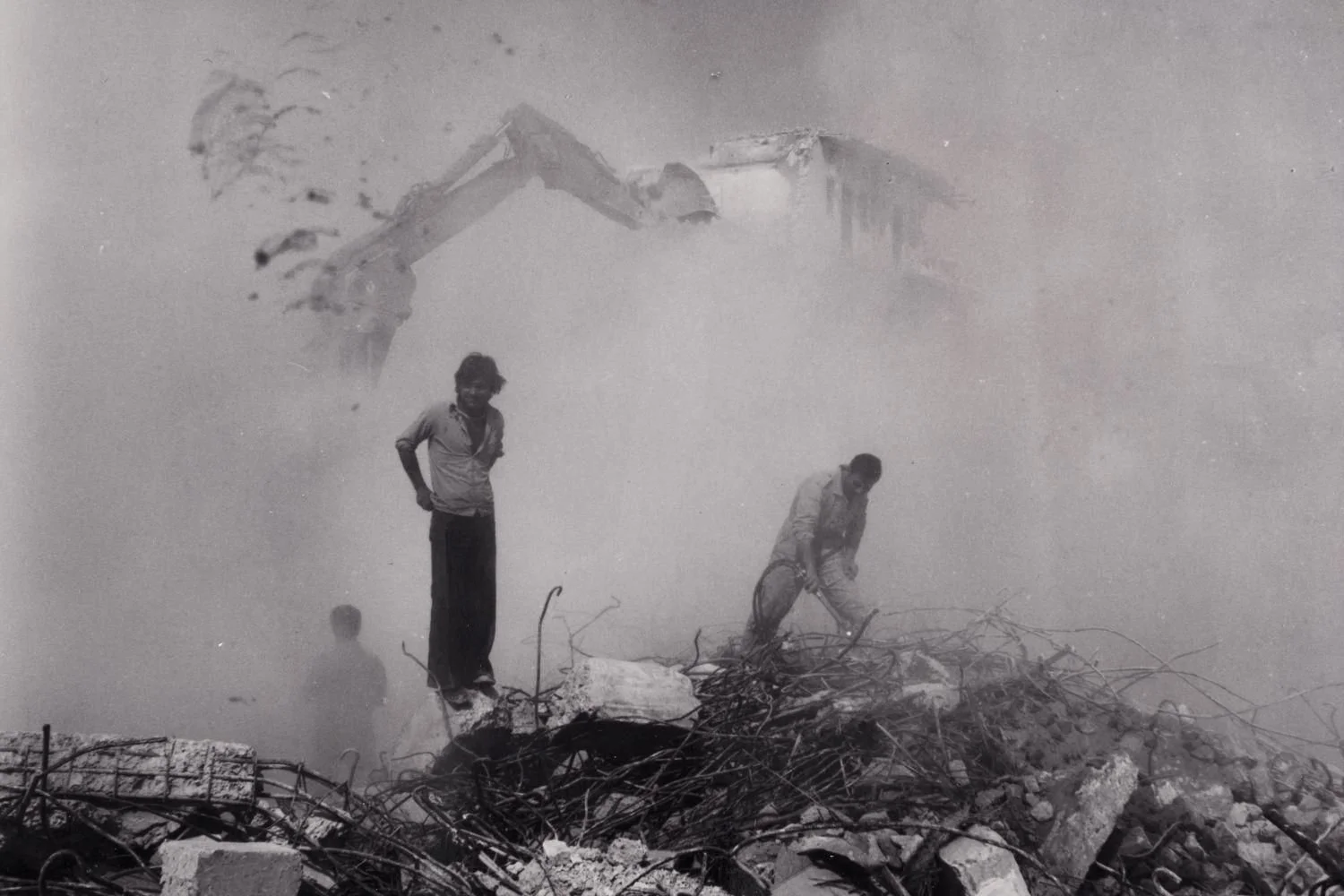
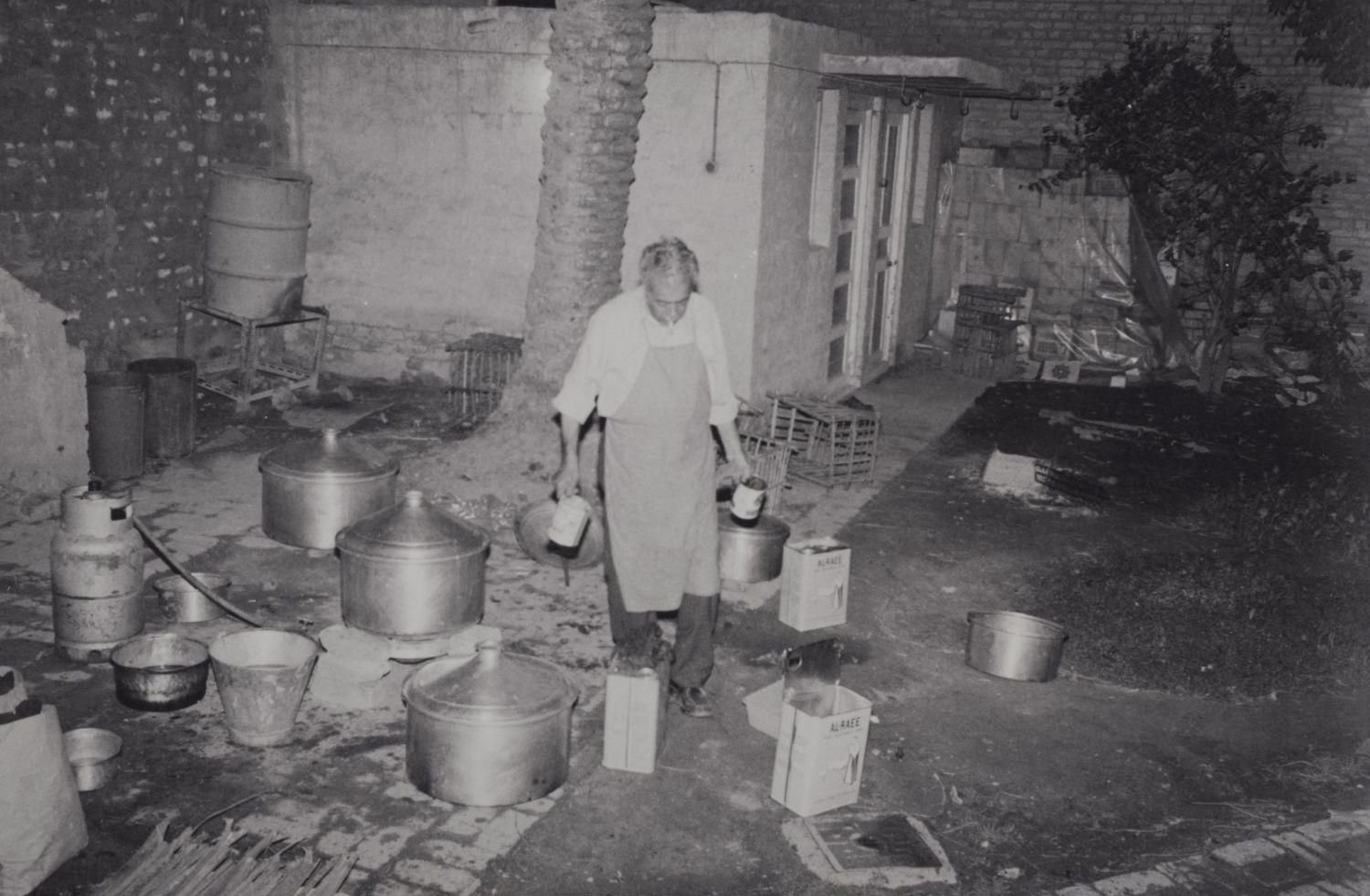
This essay transposes a mirrored reflection of two states of being– the absurd and the real –one a continuation of the other. In a sequence I have superimposed (FIG. 01-02), two men are seen in the process of a building’s demolition with the iron anatomy fragmented. A cloud of dust settles on the laborers. In a downward gaze, the gesture is reciprocated from Chadirji’s depiction of wedding preparations within an outdoor kitchen. The foreground of a human experience is then met with these two symptomatic extremes – both cosmologies against inertia and fixation. One propels movement, the demolition, the other propels movement in a social hierarchy of union. Paul Virilio’s Aesthetics of Disappearance suspends such an inquiry: “[a] desire for movement is only a desire of inertia, desire to see arrive what is left behind.” An architect’s labor of discourse is not limited to his words, but rather the phenomenology of sights that constitute his making-of. In his critical treatise Concepts and Influences: Towards a Regionalized International Architecture (1986), Chadirji disclosed: “I have therefore defined architecture as an artefact in a state of repose which manifests itself to us a form.” How then does this ‘repose’ manifest if not stabilized through the photographic image?
Although his relation to photography is mentioned only once in Concepts and Influences: Towards a Regionalized International Architecture (1986), it is important to note the context of such a placement: “Every work is the product of a multitude of telling influences. I have focused attention only on those which I feel, in retrospect, had the greatest impact on me. In some cases, the 'influences' were only discovered or photographed by me at a date long after the design was completed. Nevertheless, all the examples do represent genuine underlying influences. ”
⸻
A CALL OF CONSCIOUSNESS, SITES OF DEMOLITION
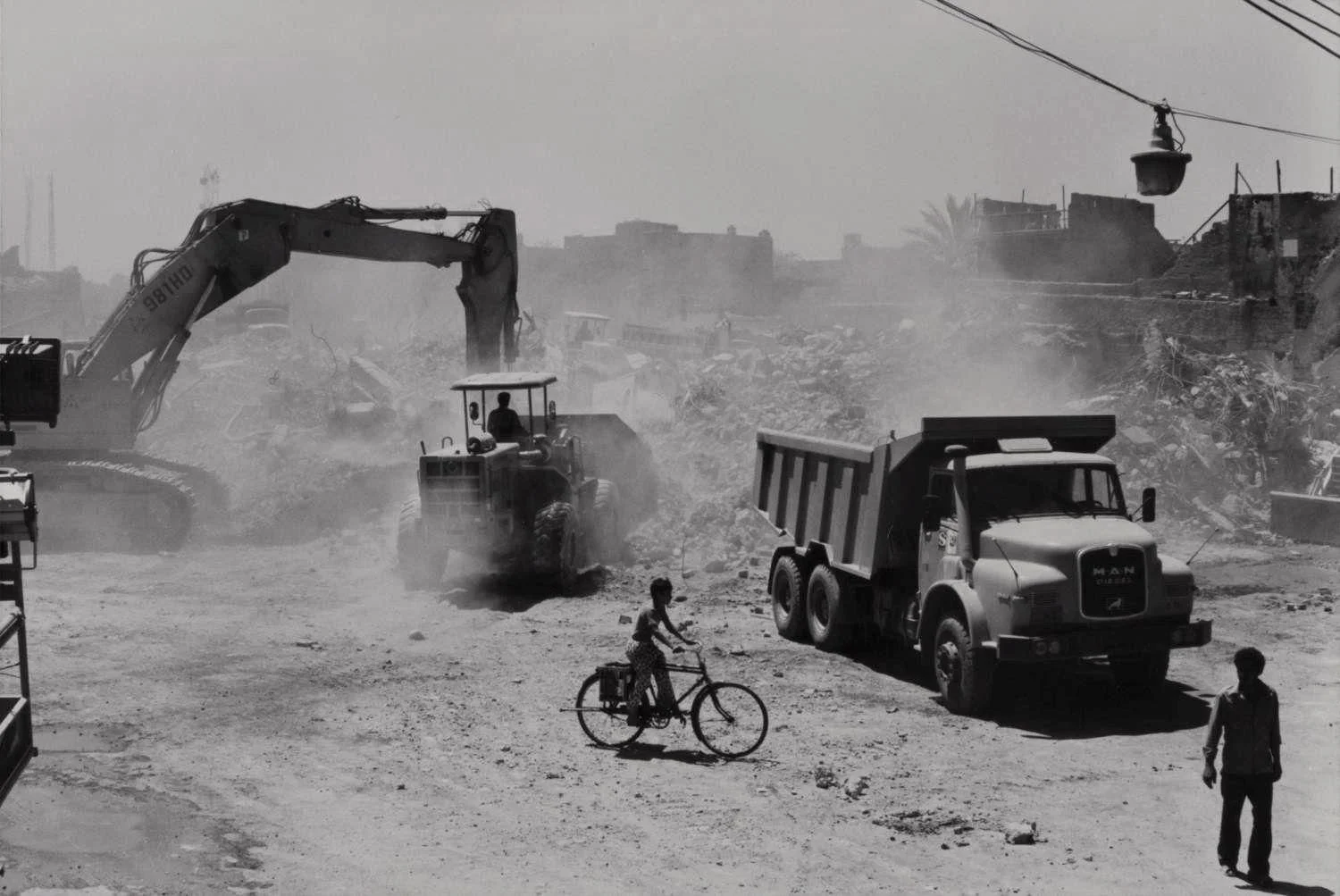
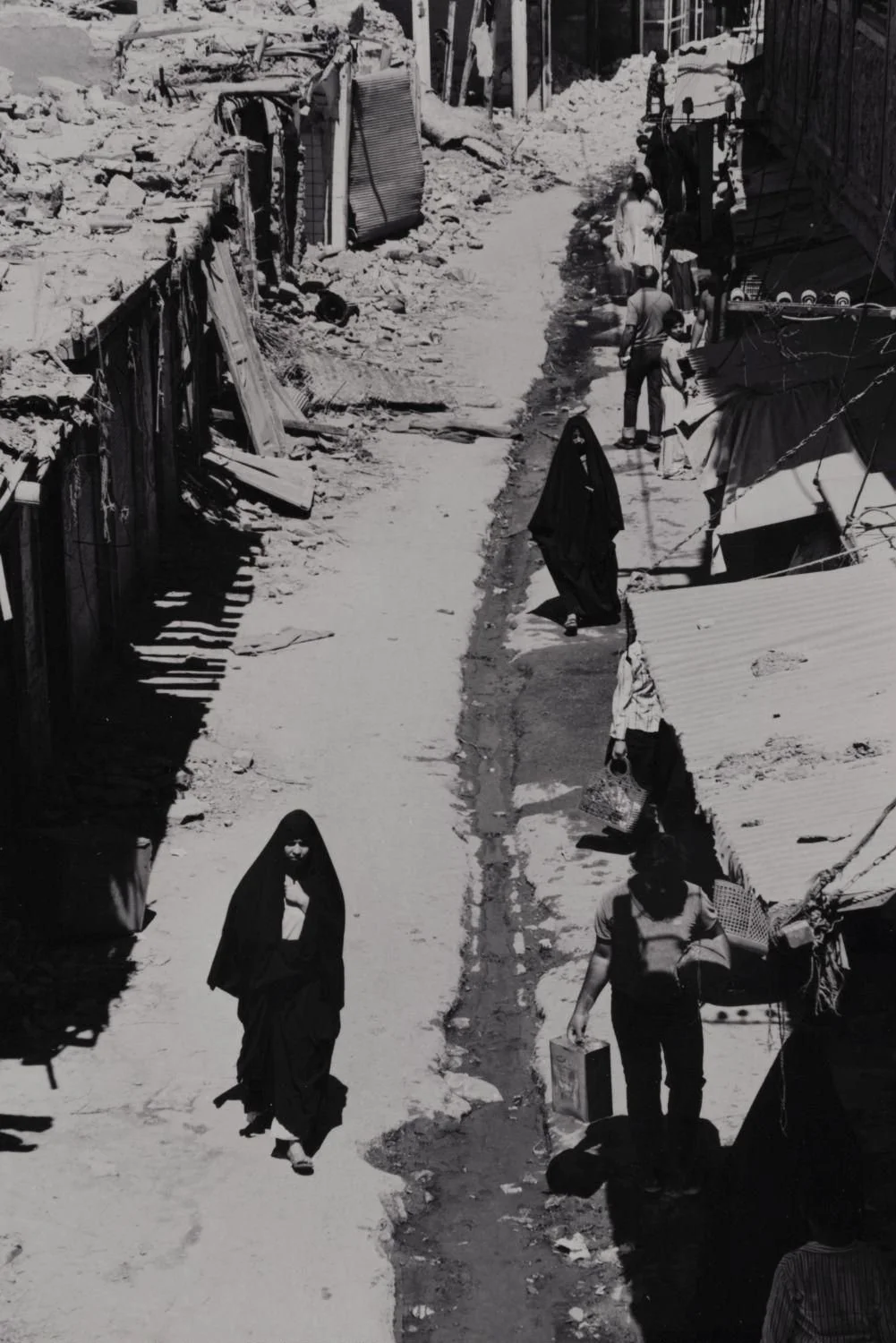
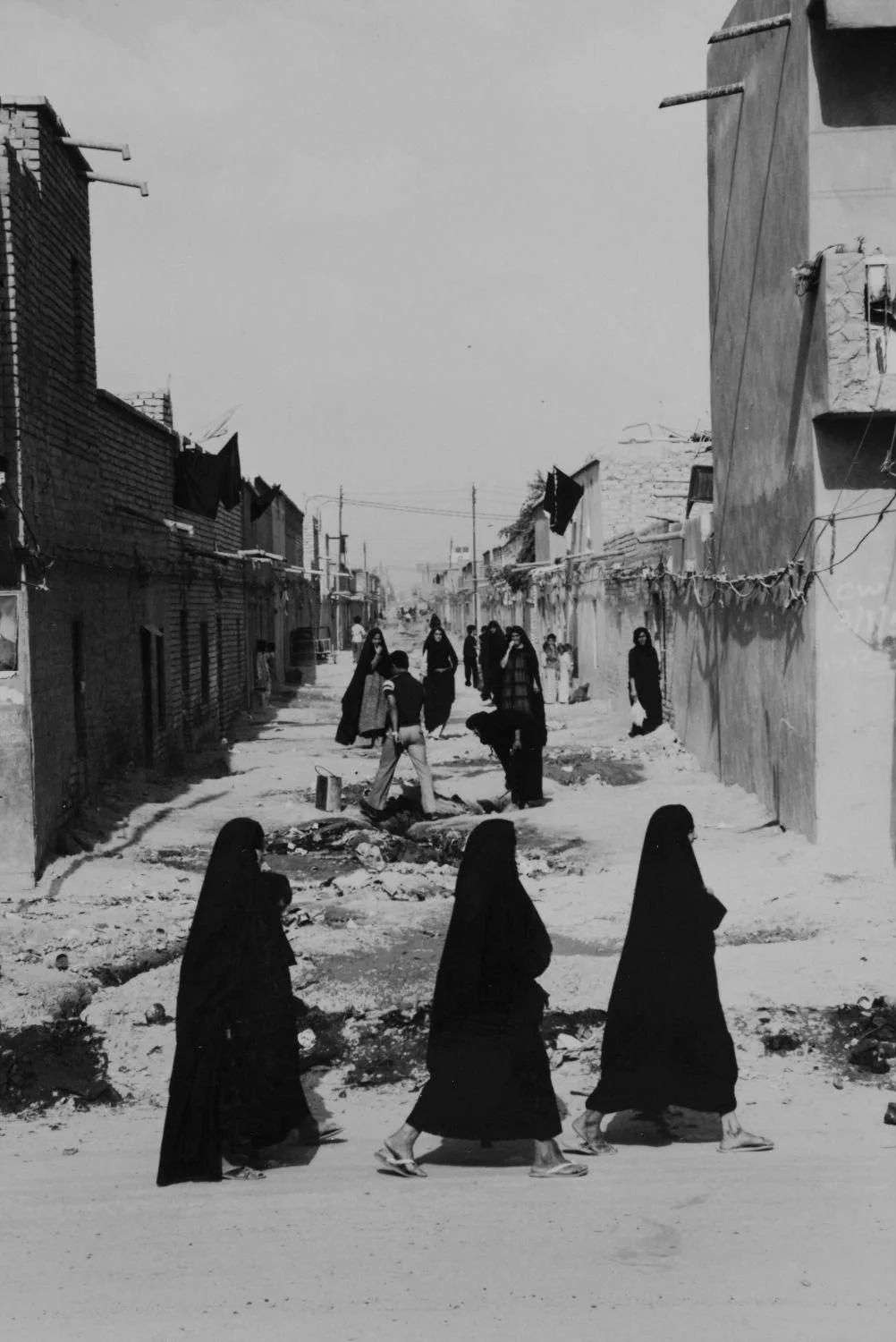
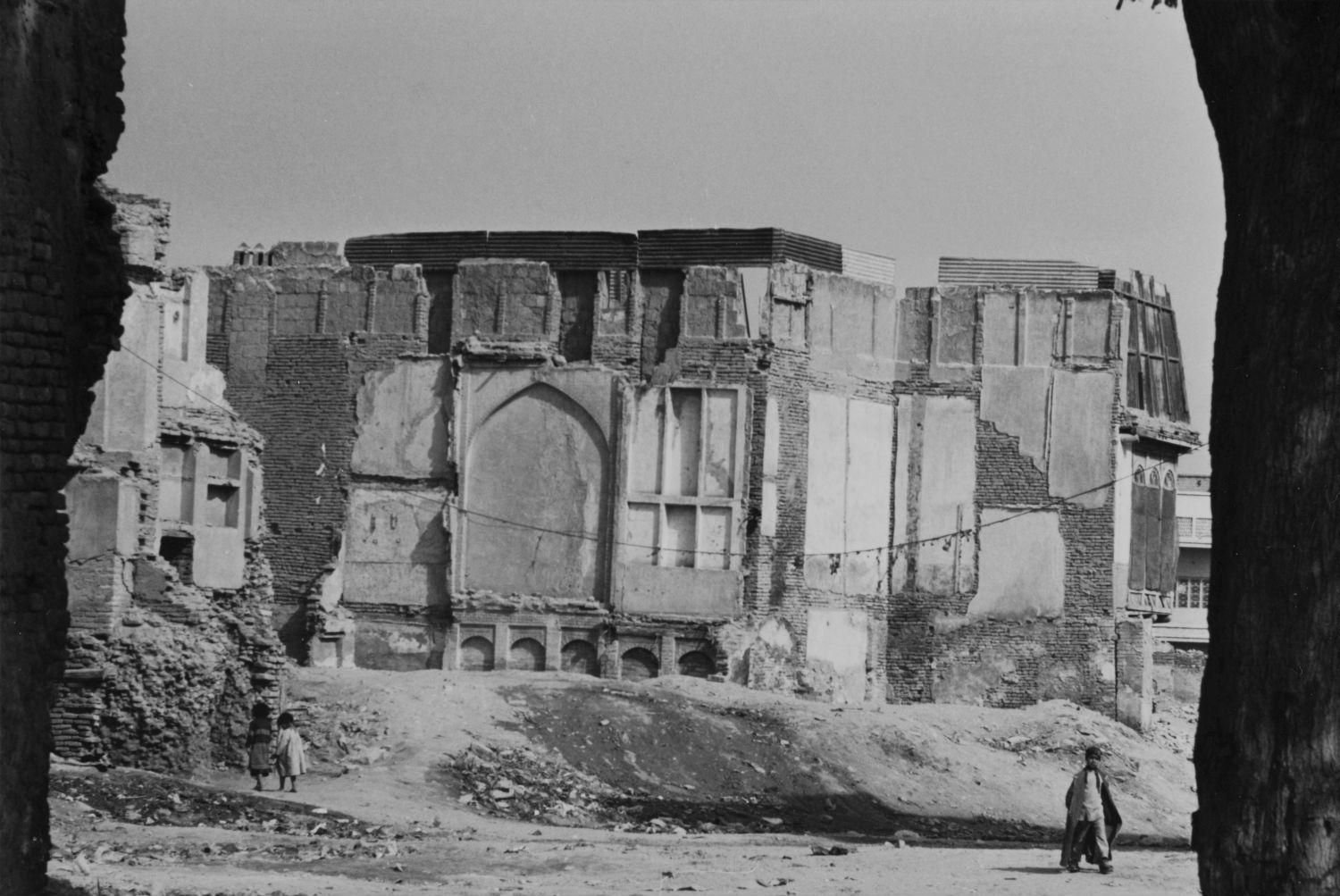
For Chadirji, the photographic medium is a mirror that portrays consciousness, discovered through the apparatus of a camera and at a chronological timeline following the completion of a design. One then begs to question the sight of demolitions – a large corpus survives within the Chadirji archive. If we can believe that Chadirji inhabited the media through his reflections in a similar method to how he viewed the ‘art’ of building, then the critique remains across both interventions of sensibility. The representation of demolitions is noteworthy of mention due to its cementation of disappearance. Image sequence FIG.03-07 showcases variant perspectives of the demolition process – yet in all of them, the human presence is felt and accompanied by the vast expanse of land that is in a state of transition. Black-veiled women cross the street, a boy with a bike is seen in the area of current ‘destruction’, a young boy is framed in contrast to the remaining wall of a domestic building. The photographs form a gesture that even within sites of demolition, public life is not excluded from the perceived devastation. Rather, they produce a phenomenon of erasure that is carried within the eyes of the observers. There is a parallel world in which traces are left that can be read like a notation, almost as if the braille script is the remaining architectural elements that survive on the neighboring standing wall. For instance, a frame of reference is FIG.07, wherein Islamic horseshoe arches remain imprinted within the tactility of the brick and stuccoed wall, although the interior organs of the building have been gutted. Chadirji’s sensitivity to such sites then begs to question the liminal authenticity of transition. Sites of demolition become temporary sites of passage, now opened to the passerby’s circulation of the city. Children are seen amongst the occupiers of such areas, cementing a sense of scale and material displacement that alters the very navigation of an urban corridor’s erasure and yet reorientation of a citizen’s belonging to their neighborhood.
A contemporary of Chadirji and frequent collaborator, Iraqi artist Jewad Selim’s abstractionist portraits of city life are also deconstructed realities: the female figure in Selim’s The Watermelon Seller (1953) (FIG. 08) is rendered under an unrecognizable form: the body is composed of parts, each indirectly isolated yet compositionally whole with the symbol of the crescent moon in the guise of a watermelon’s arched form. A period of assimilation to the ‘absurd’ but real body can then be imagined as a pervasive truth that carries forward Chadirji’s statement of repose, bridging into a final form. In the prologue of Concepts and Influences, Venturi asserts: “As architects of our time, we are here not to suppress our culture, but to express it; perhaps less to solve our dilemmas than to reflect them. We can agonize as critics, but we must go on as artists.”
Camus' framework within The Minotaur or The Stop in Oran may provide an appendage of aversion to the architectural-centric practice of Chadirji as represented historically, in his quest for understanding:
“There are no more deserts. There are no more islands. Yet there is a need for them. In order to understand the world, one has to turn away from it on occasion; in order to serve men better, one has to hold them at a distance for a time. But where can one find the solitude necessary to vigour, the deep breath in which the mind collects itself and courage gauges its strength? There remain big cities.”
It is this ‘turning away’, this practice of distance-making, that the photographic medium engenders as visible in the extract archive of Chadirji. The mind is allowed to ‘collect itself,’ building an atlas of recognition that then consciously grows into the seams of a structural anatomy. This is in parallel to the phenomenon witnessed of a ‘cultural osmosis’ described by Chadirji, how exactly a new structural anatomy is built from the spine of ‘tradition’: “It was a process of cultural osmosis within the capability of that tradition. In this way, the dissemination of form in the pre-modern era was almost always accepted unconsciously or acquiesced in as a natural development of that tradition and culture.” I repeat again the words of Camus: “In order to understand the world, one has to turn away from it on occasion; in order to serve men better, one has to hold them at a distance for a time.” In the context of building a new vocabulary that will not succumb to the caricature of a prescribed tradition, Chadirji had allocated a great distance through the photographic medium to be able to comprehend the changing environments at a speed of recognition. A strong anecdote of virility is witnessed that cements a concept of Venturi's severe call towards ‘expression’ rather than ‘to suppress’. This velocity of photography is essential as it suspends time into a vessel of permanence that can then be understood in the vertigo of time elapsed.
ORIENTING A POLITICAL FRAME: KAMIL CHADIRJI
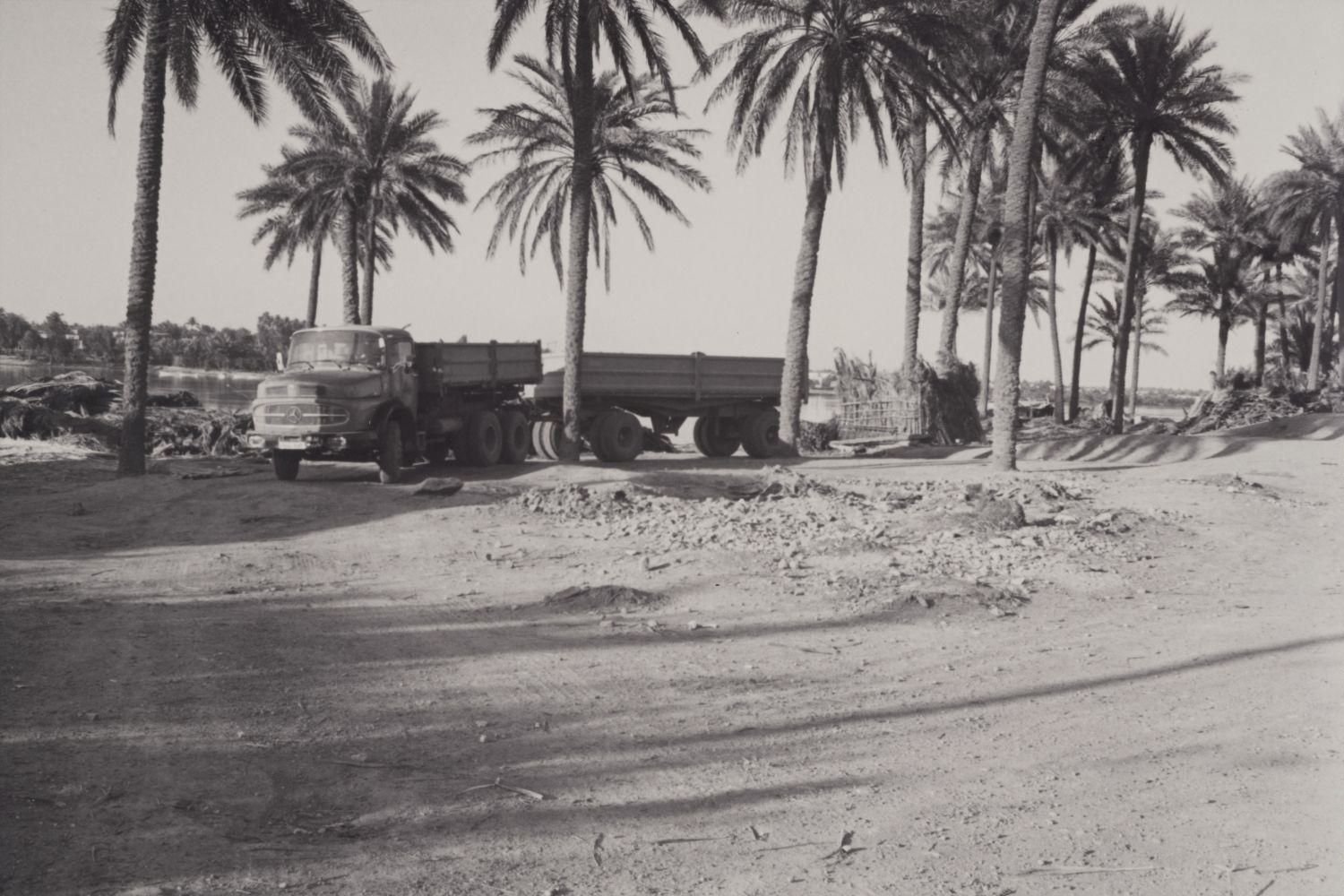
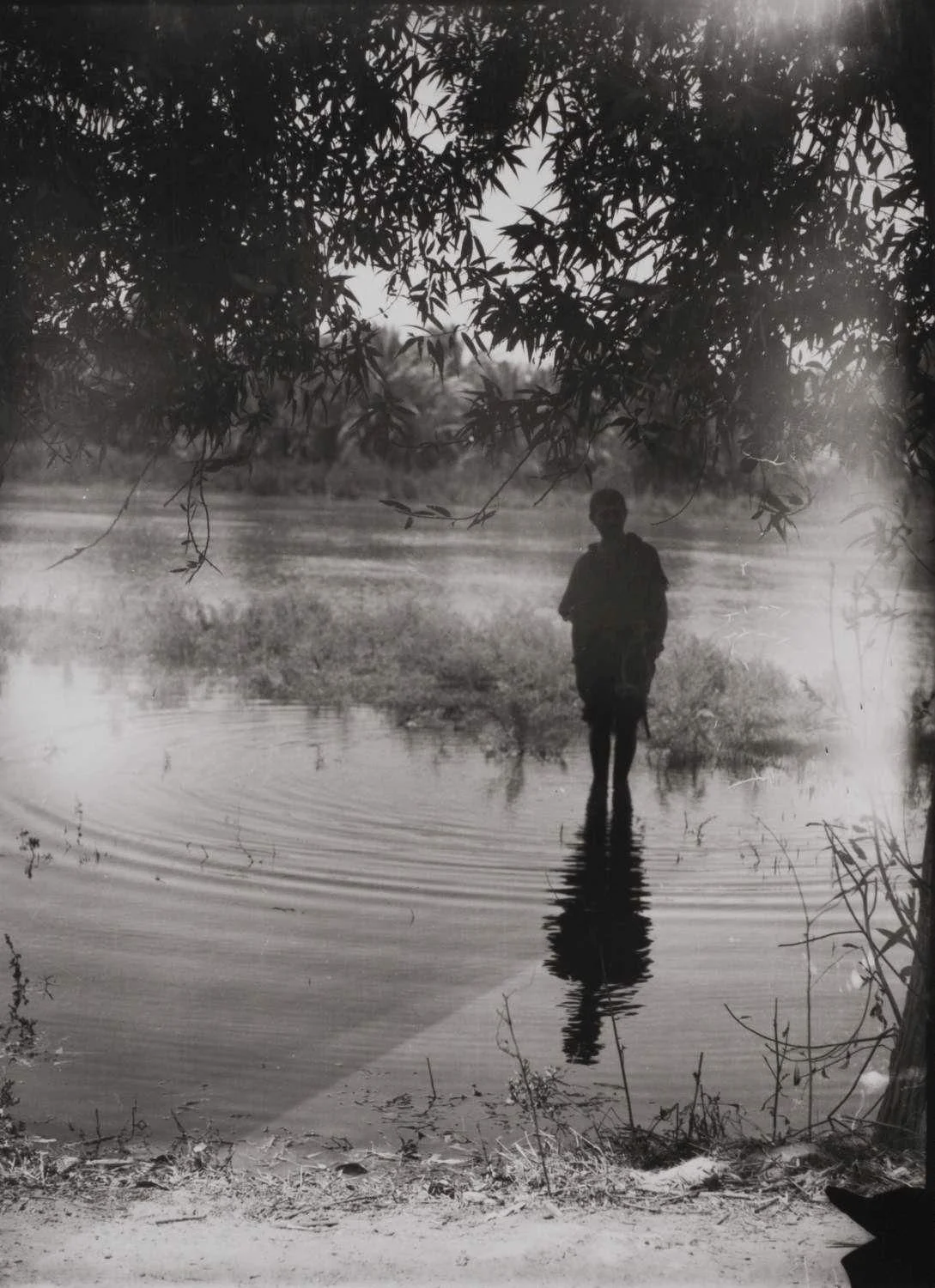
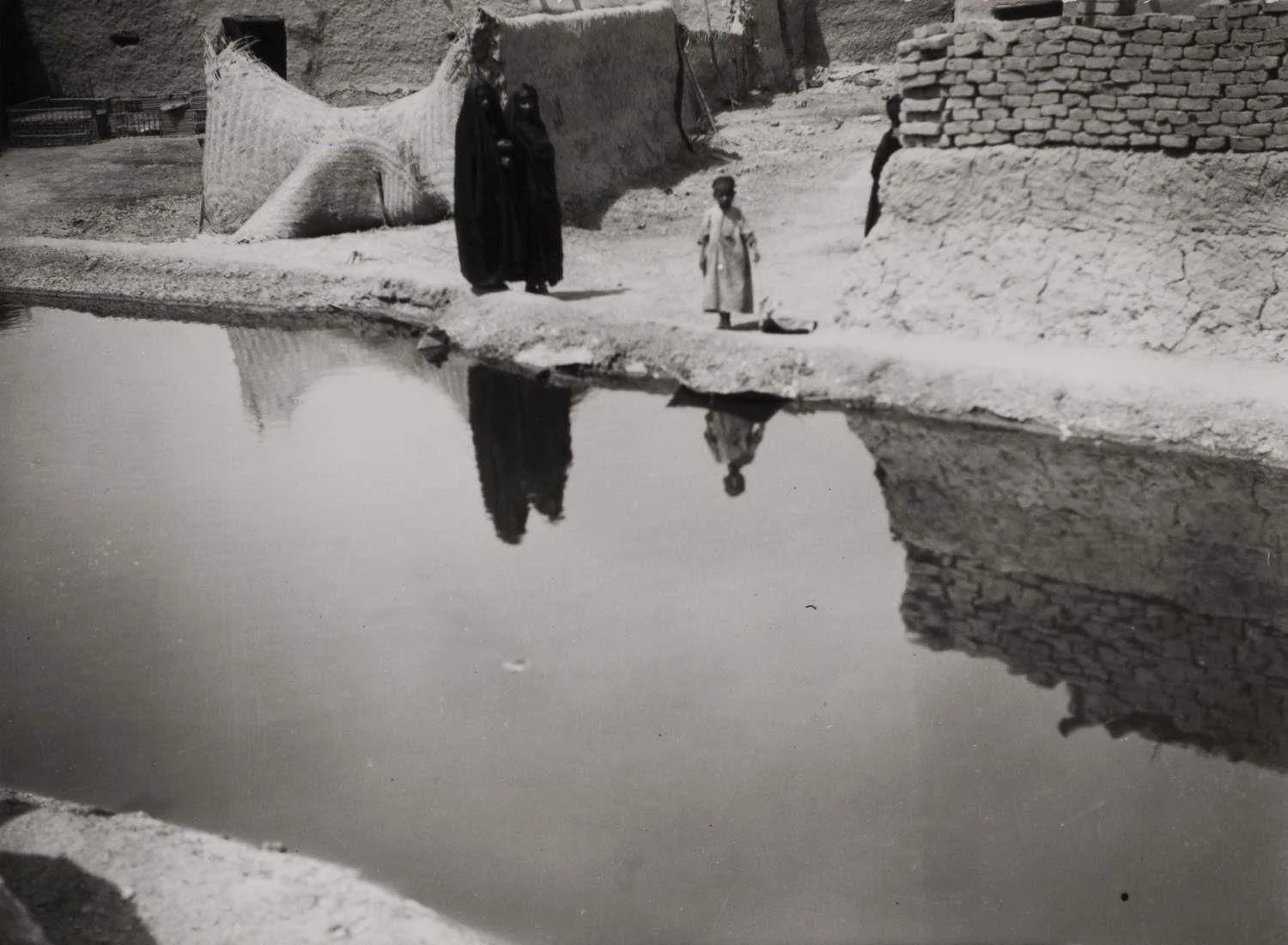
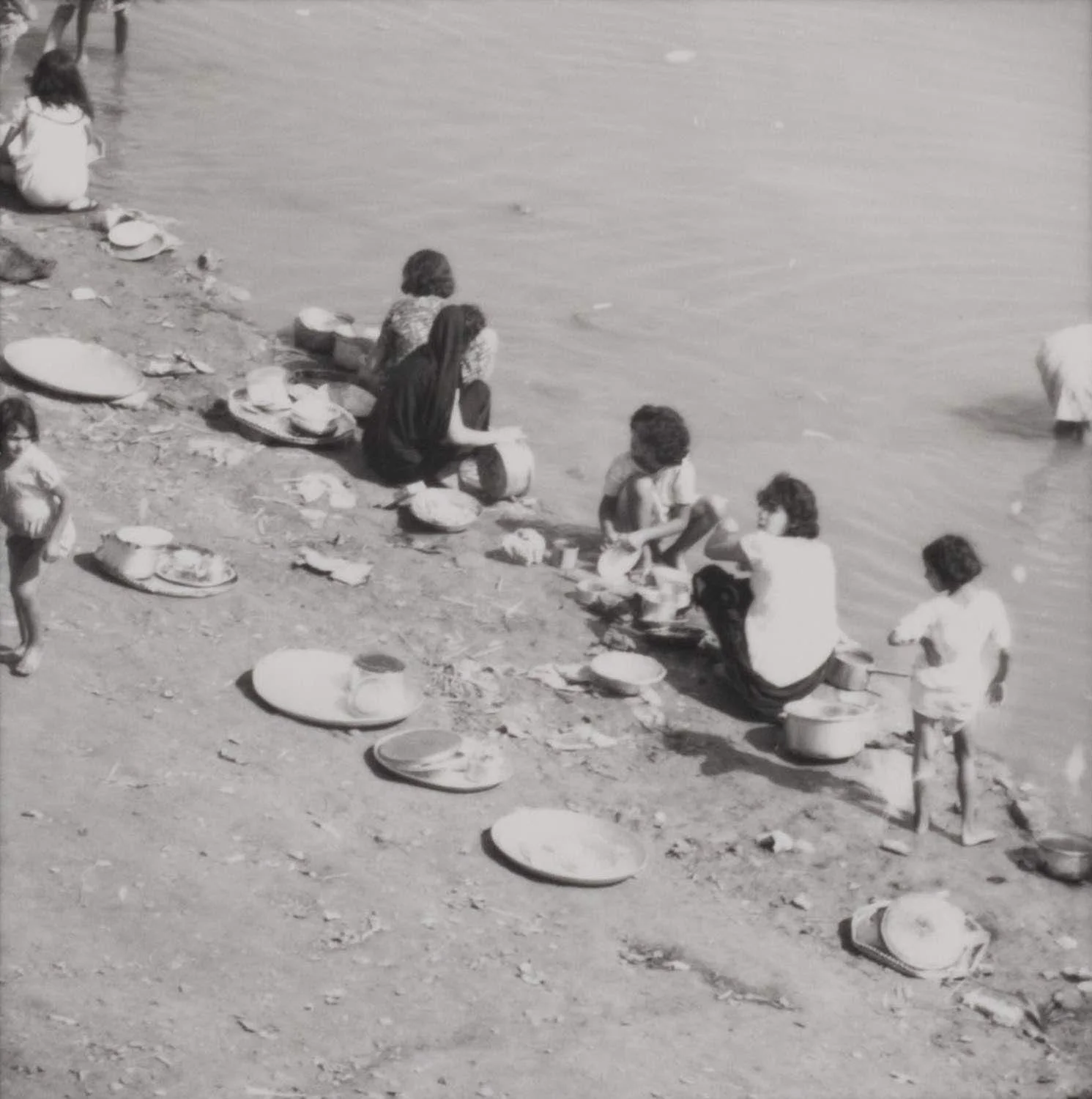
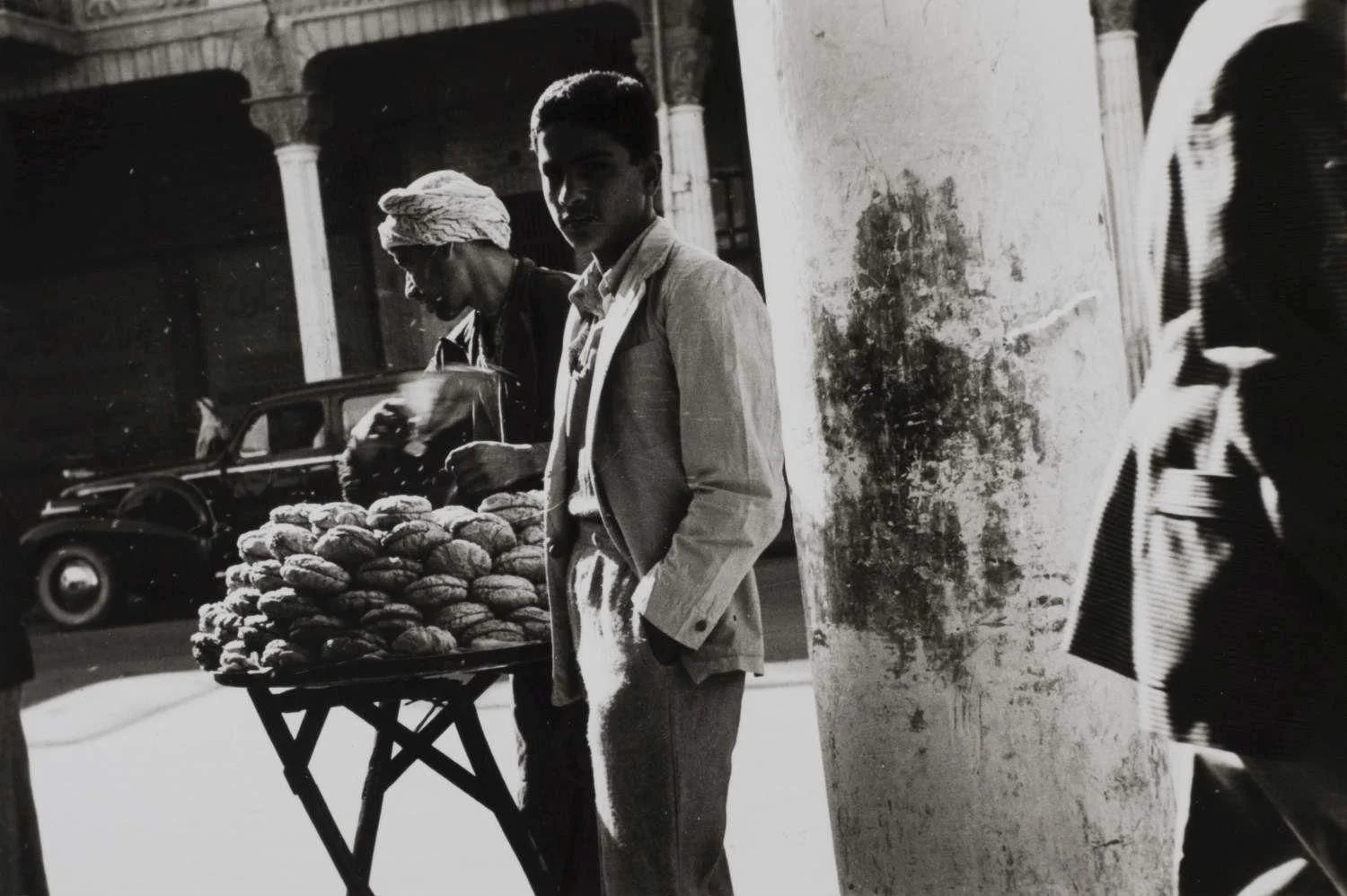
In the lifeblood of Rifat Chadirji, one can position the genealogy of references that stimulated an engine of photographic production stemming from the 1920s – 1970s. His father, Kamil Chadirji (b.1897), an Iraqi politician and leader of the National Democratic Party, held an extensive photographic archive, now bequeathed to MIT, providing a shelter of association to what would become the methodology of his son. Select scenes (FIG.08-19) depicted inconclusively: rural architectures within the marshes of Iraq, sullen reflections on shallow water, the toppling of a statue of General Maude on horseback in Baghdad, bread vendors, the washing of pots on a riverbank outside Baghdad, collection of water from an irrigation canal, view of a kiln. The descriptive captions provided and edited by MIT resolve to configure an analysis of action or sight that consolidates a state of motion and industry.
Kamil’s images surrender to a framing device of proximity and distance that requires a latitude/longitude reading of an image – yet, his son argued that Kamil’s work was solely artistic, ‘of artifacts’, while his was ‘anthropological’, to form a survey. They form a schism, as the direct atmospheres depicted by Kamil do include a large interest in depictions of labor and industry, which do not forge solely an ‘artistic’ approach - instead, the images provide a central aptitude for an economical view of survival and life that elicits an anthropological undertone. Figures are isolated in penetrative environments – whether it be marshes or the door of a building – and a scale of consciousness is always decipherable. In the case of the bread vendor (FIG.12), a large column becomes a vertical body to separate the gaze of the young boy from the incoming traffic – a stable axis in a transitory frame. The essence of unfolding is particular – the turned head of the second vendor, with his veins palpable under the sun, or the imprint of black that stains the white column forewarning of all the bodies that once lay their backs to the powdery surface. There is an encounter that can be witnessed and materially indexed upon a social plane.
This initial archive of Kamil propels us to question how a young Rifat came to see the world in the paralysis of a frame. Photography becomes an active body of a citizenry within their home country. The technologies of governance can then be comprehended through an analysis of the powers of space; with Foucault proposing, “Space is fundamental in any form of communal life; space is fundamental in any exercise of power.”
Kamil’s archive may then be investigated as the first exercise of asserting a cohesive, organized domination of gaze which although subtle, is also evidence of a profound ability to decipher forms of representation in the early 20th century. In the wake of a Western evolution in thought at an unprecedented scale, Baghdad was a central arena for the Arab world’s changing identity. It reminds of Camus’ anxiety within Helen’s Exile: “Europe no longer philosophizes by striking a hammer, but by shooting a canon.”
ON SYMPTOMS OF MODERNITY
While architecture used to be a primary medium of communication to delegate a profound desire for regional power and aesthetics, World War II altered the apprehension of the built environment, as Rifat Chadirji identifies: “With the deployment and franchise of production in different localities and regions and the increasingly international nature of production, there has been an attendant loss of regional differentiation. Since the Second World War, production has become a conglomerate of unintegrated technologies lacking a basis in a harmonious and mature complementary set of values.” The emphasis on ornament and representation in modern architecture was supported by increasing tensions between decolonization and rising nationalism, to define modern architecture with a spine oriented towards the “particularities of a given place and population, as well as their progress toward future prospects.”
The independence then of regional architects was contrasted with the enduring symptom of colonization that was brought to Iraq from the emphasis on importing foreign architects during the shifting political landscapes of contemporary Iraqi history: from the British mandate, to the monarchy, to the Republican period. Scholar Mona Damluji investigates this axis of transformation, asserting how the state commission of Brian J. Cooper, a British architect of the colonial era, negated the local context for the construction of the Iraqi Parliament building and “imposed a vision of modernity modeled on colonial precedents in India and the metropole.” American architect Frank Lloyd Wright’s plan of central Baghdad in 1955 provided a “Utopian landscape that relied on Orientalist interpretations of Iraqi tradition, conjuring imagery from the Arabian Nights and biblical lore as its literal cornerstones.” These examples are meant to supersede the notion that Chadirji, and artists such as Jewad, had formalized an axis of local involvement that took into consideration a multitude of regional differentiation, rather than a mimesis or cynical investment into the aesthetic regime of particular geography.
The great historical question of time and the spatial parameters that underscore a certain ‘historicism’ were in a profound fluxus that dominated the truth of conduct. Understanding if Chadirji was a ‘modernist at heart’ disembodies what modernism may constitute, while critics such as Kanan Makiya had referenced Chadirji’s ‘superficial’ relation to Iraqi heritage. What would this mean for the extant photographic archive if indeed superficiality was the leading symptom? I disclose that such a reading of Chadirji disassociates two central modes of consideration, for the negotiation of value and the exploration of a changing identity are underscored within Visions of Iraq, as Bernhardsson states: “Chadirji was developing an Iraqi architectural aesthetic that did not have a singular feature and that was based on his relationship to and interpretation of Iraqi history……Iraqi architects who came of age in the 1950s had the knowledge, independence, and self-confidence to articulate new visions and structures for their country.”
This independence and self-confidence are critical: for an apprehension of two states of belonging and the immense measure of influence and osmosis of styles precipitates a greater arc of associations. A dissonance in harmony may be the primary erasure of a national character, an amputation of a wide scale. Camus discerns, “Deliberately, the world has been amputated of all that constitutes its permanence: nature, the sea, hilltops, evening meditations. Consciousness is to be found only in the streets, because history is to be found only in the streets – this is the edict.” This transition from the wild intimacy of a natural organization and presence of symbols to an urban labyrinth of widely unassimilated motifs could be the impetus for the value of such a photographic archive, where the very acts that constitute a sense of belonging are rendered impassible, immutable. The vision of something that once existed constitutes a form of permanence that has been disproportionately forgotten in the mud of industrial transition. Yet, Chadirji had never believed the archive to be comprehensive, noting his ‘mistake’ within a final interview:
“I didn’t know how these photographs should be taken. [In hindsight], I know where I made mistakes. For instance, when photographing one of the traditional houses in central Baghdad, I should’ve photographed the street first, and then the entrance and then the house. I only photographed the house and missed the context.”
BUILDING THE PROJECTED IMAGE
Camus verifies: “Consciousness does not form the object of its understanding, it merely focuses, it is the act of attention, and to borrow a Bergsonian image, it resembles the projector that suddenly focuses on an image.” So, if consciousness becomes the great bridge to solidify the ‘act of attention’, then Chadirji signifies the projection of this reality that cannot be obscured nor rejected. He, as an architect and as a man, prioritizes a focus that has the same architecturally significant ethos as his built structures - regardless of audience.
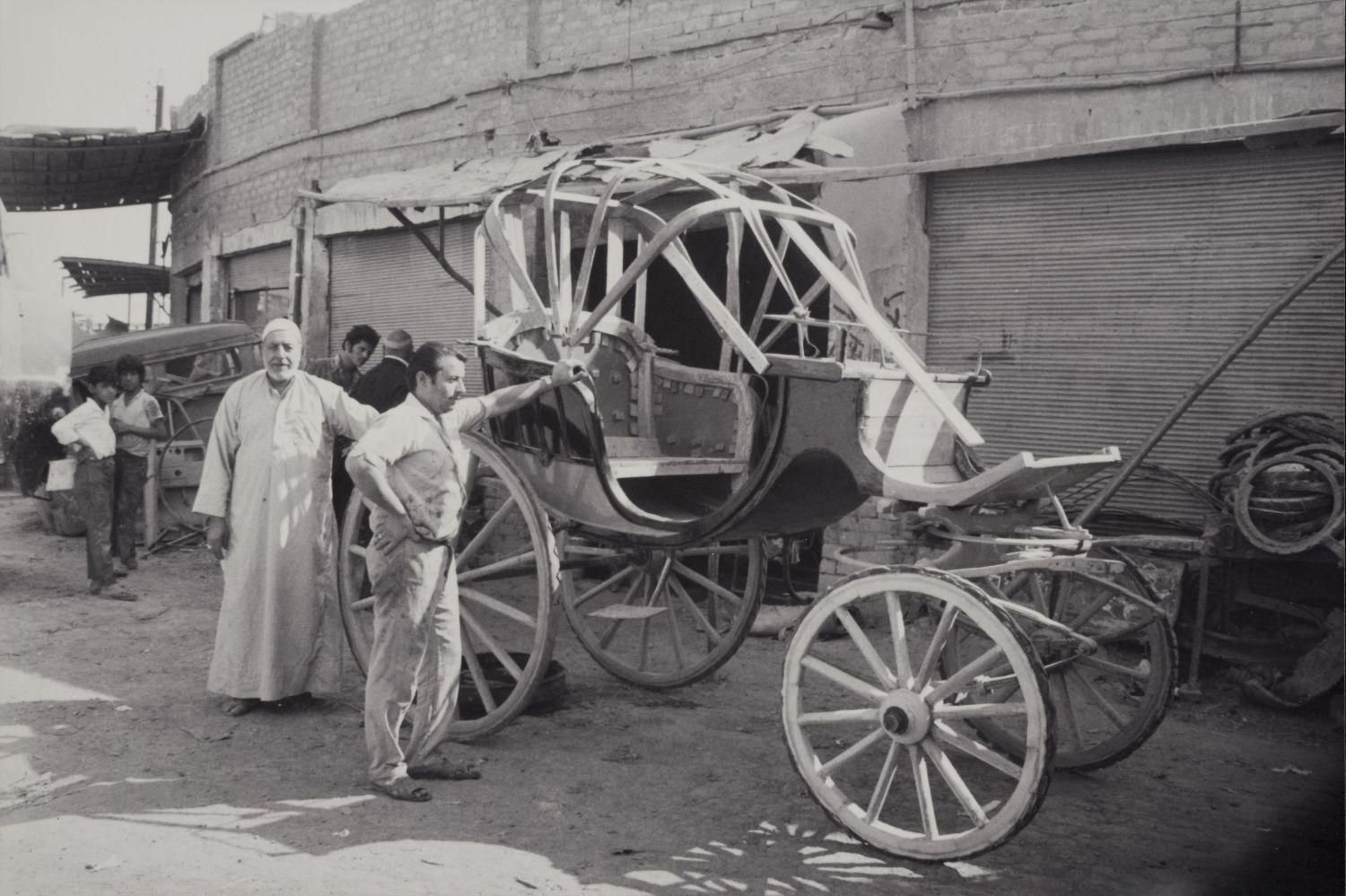
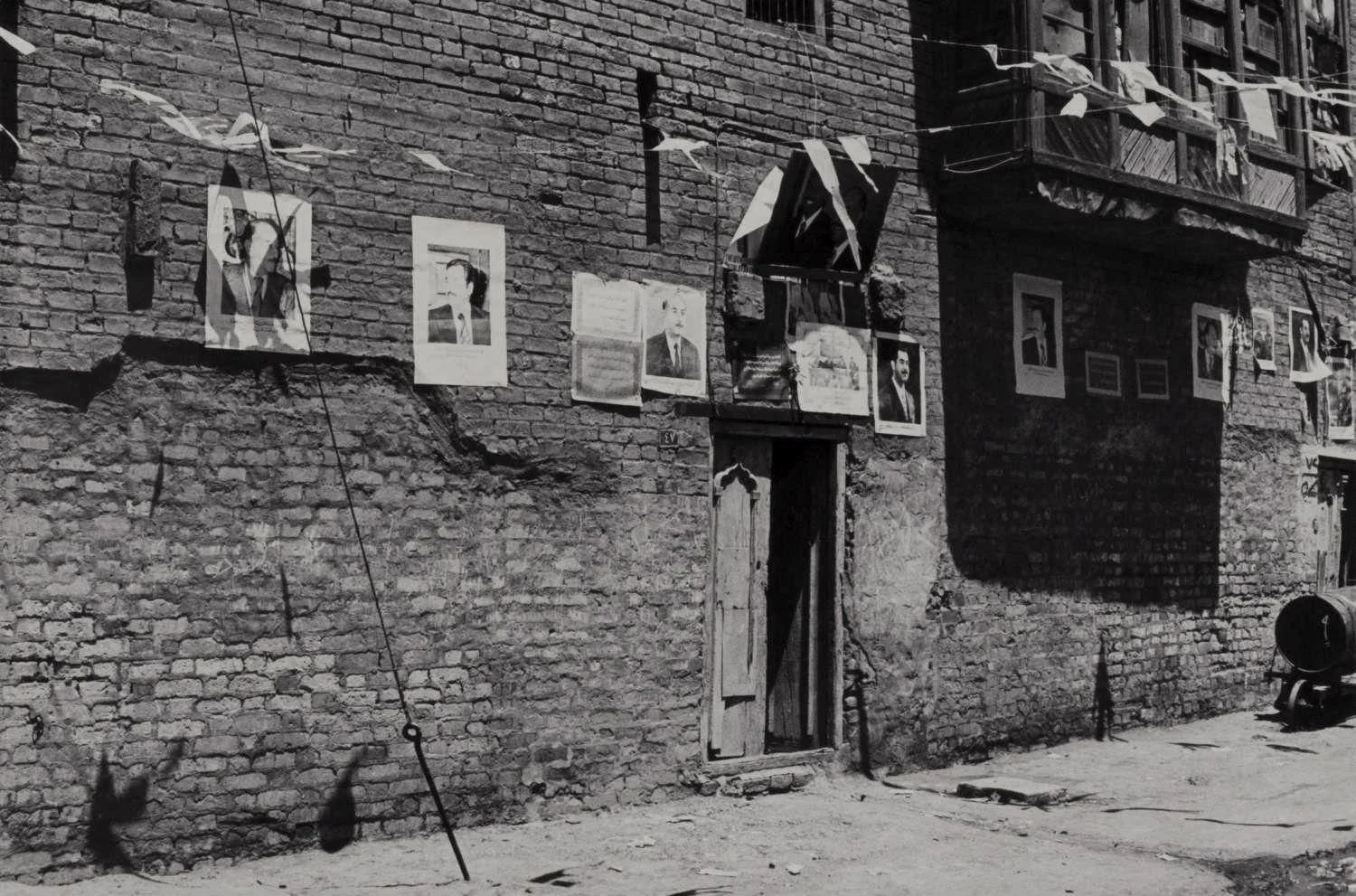
In the archival record, temporary signage plays a key role in the political imaginary (FIG. 20,22,23). Walls outfit and cars placated with advertisements. Vehicles of transportation: carriages (FIG.21), automobiles, even the infrastructure of a carriage, are rendered of importance in the lens of Chadirji. An architect, if he was only limited to photographing his buildings, he would prove a personal haste to only remember his legacy. Such a diverse proposal of value, across the social context imaginary, solidifies the project Chadirji had begun and assembled. Foucault within an interview had suggested the minimal assertion of the architectural practice, which will be used to dissect a core ethos:
“It is true that for me, architecture, in the very vague analyses of it that I have been able to conduct, is only taken as an element of support, to ensure a certain allocation of people in space, a canalization of their circulation, as well as the coding of their reciprocal relations. So it is not only considered as an element in space, but is especially thought of as a plunge into a field of social relations in which it brings about some specific effects.”
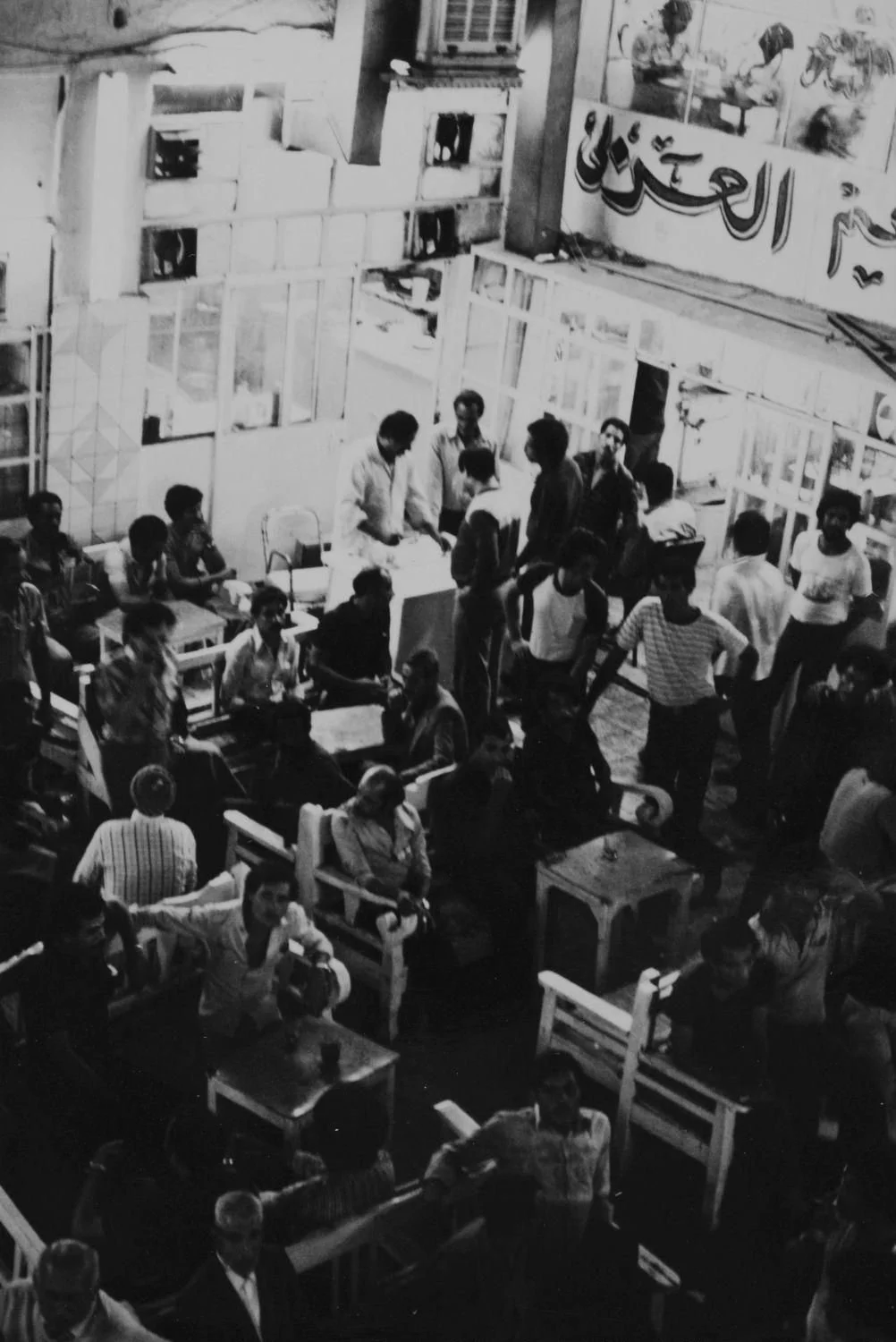
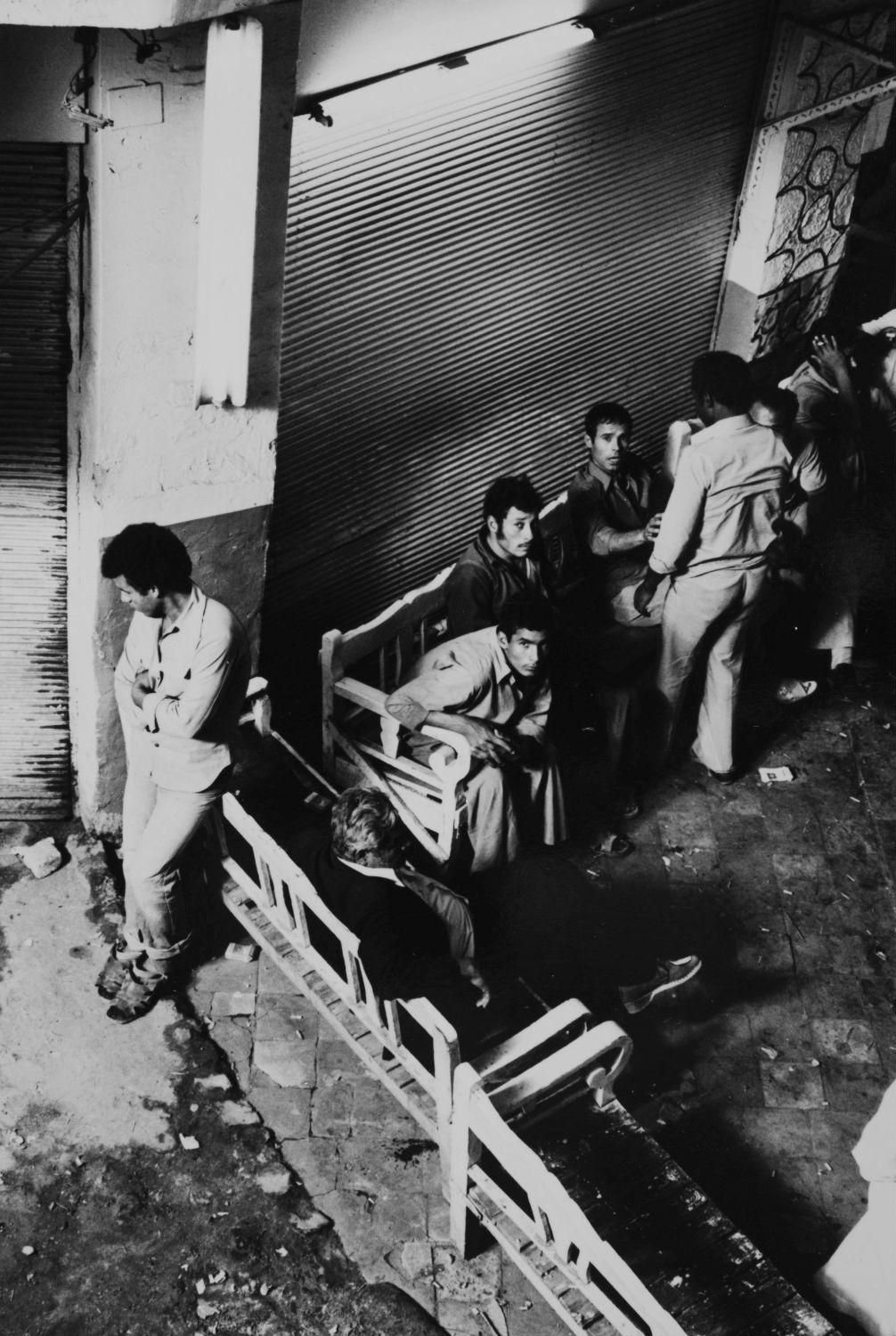
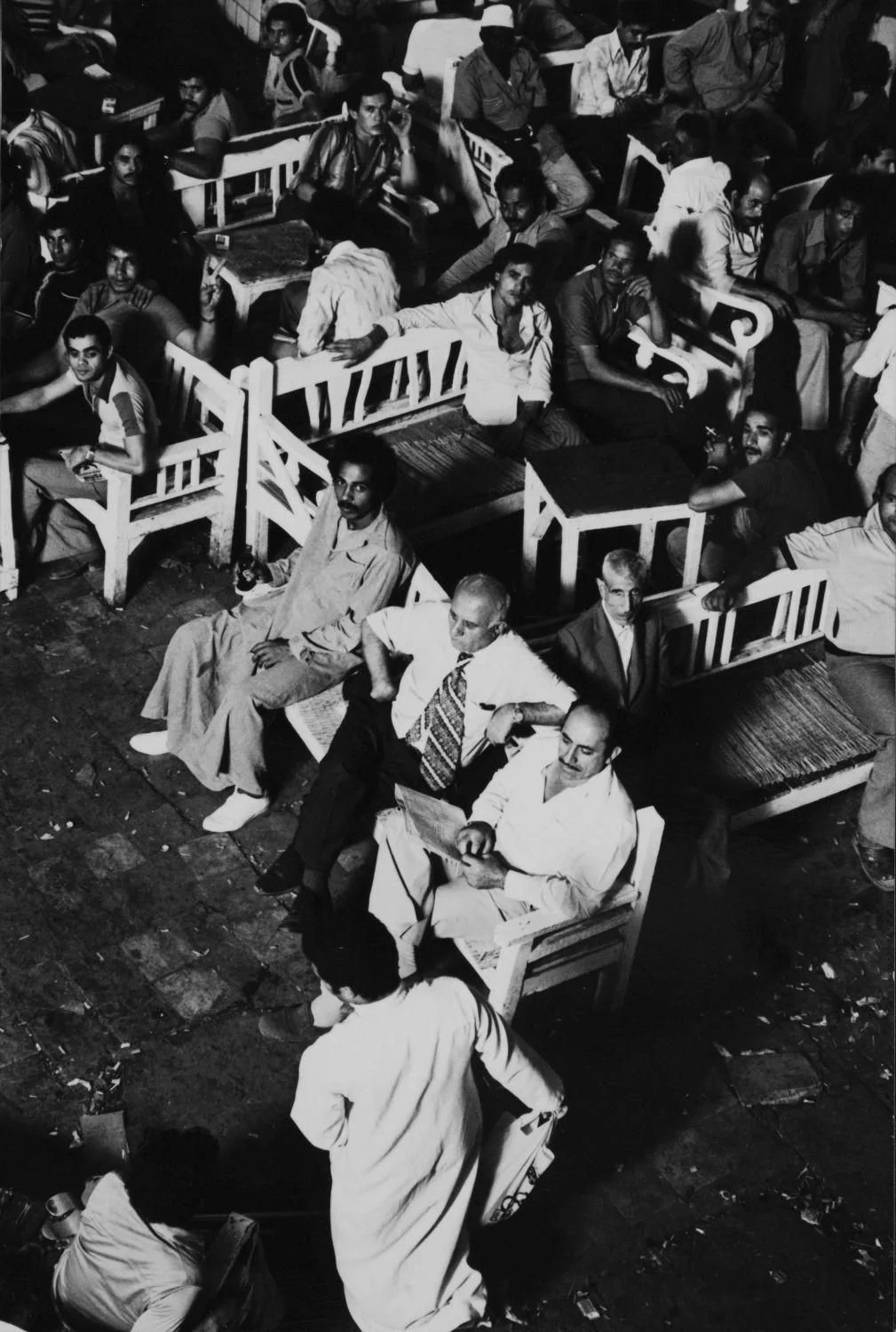
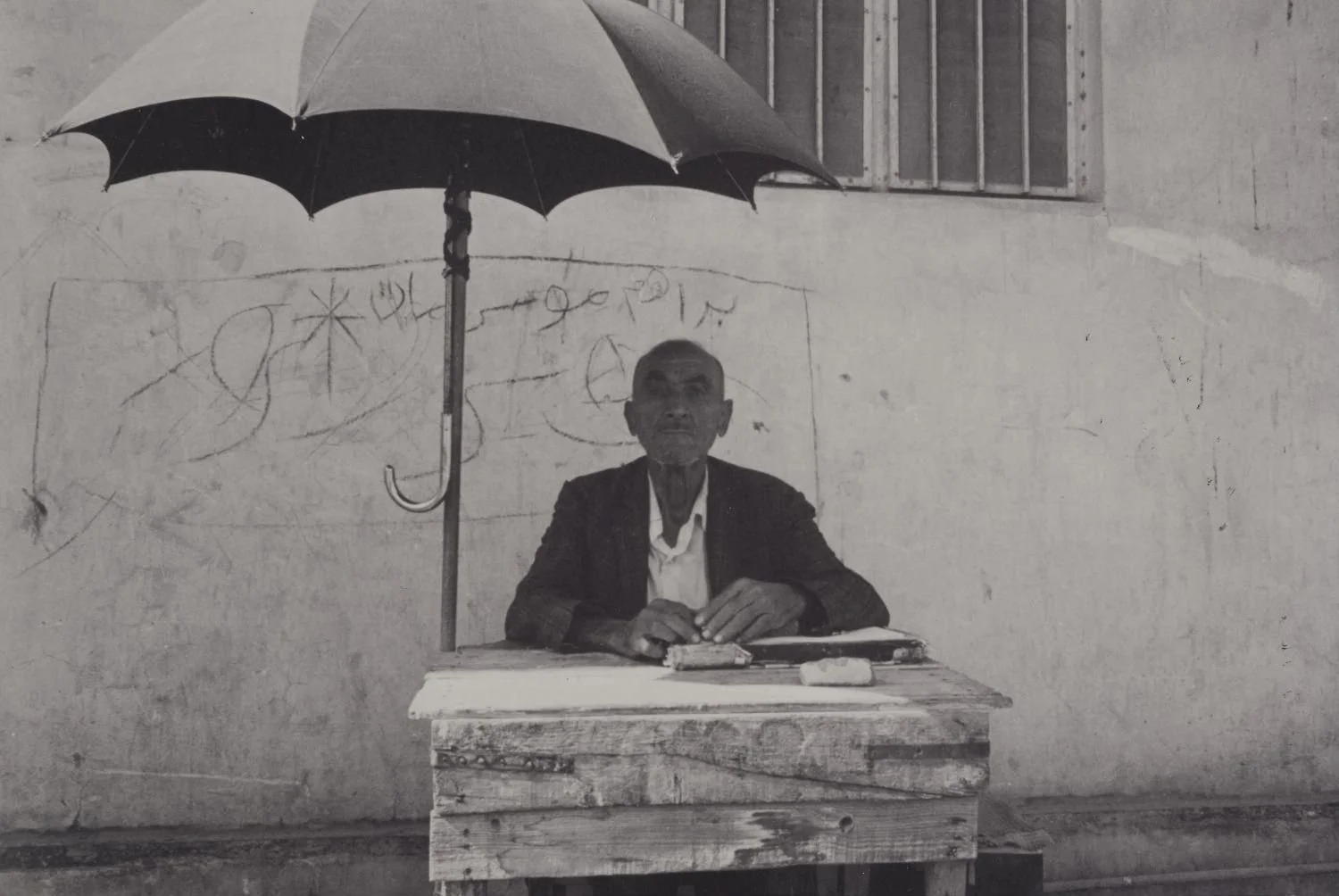
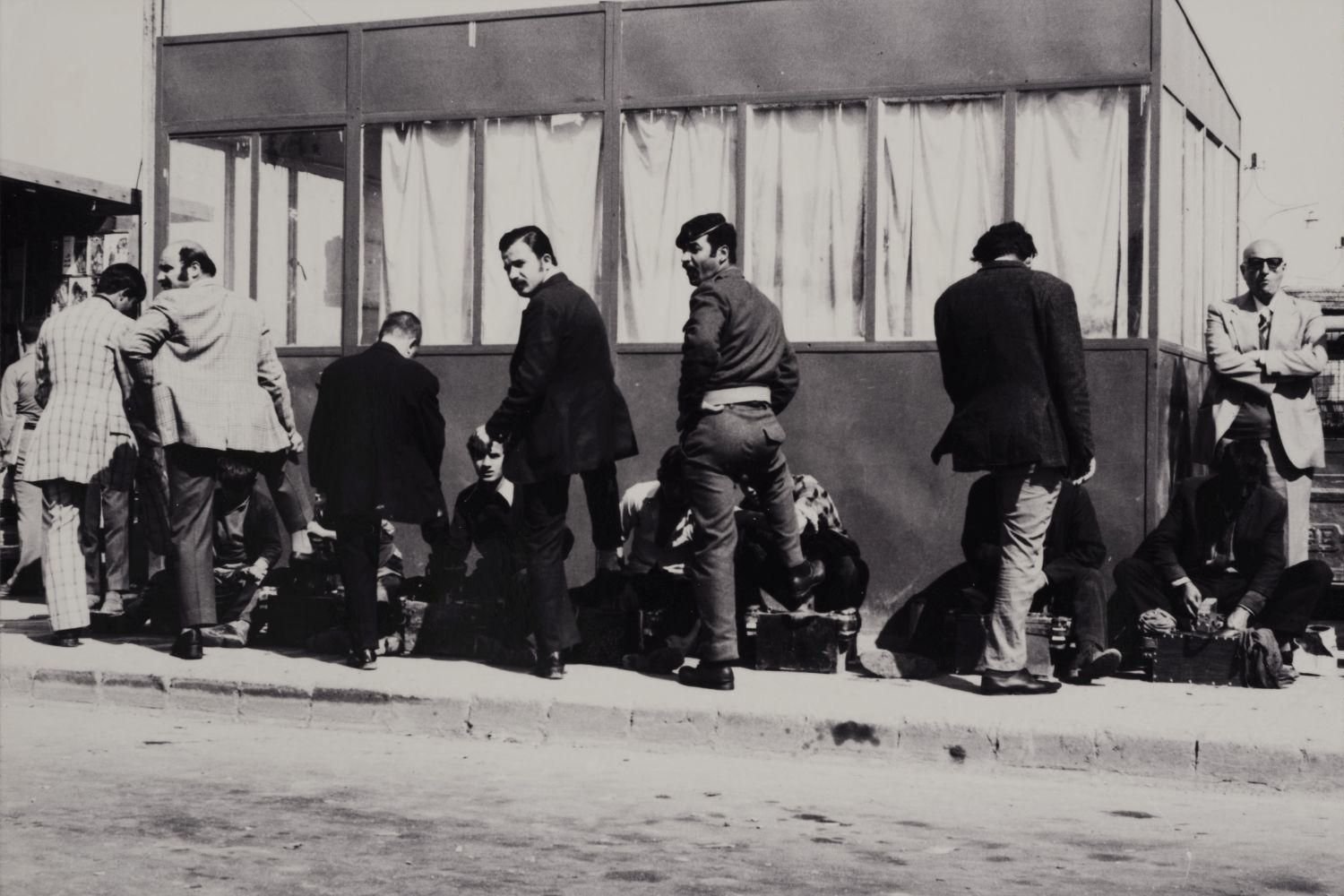
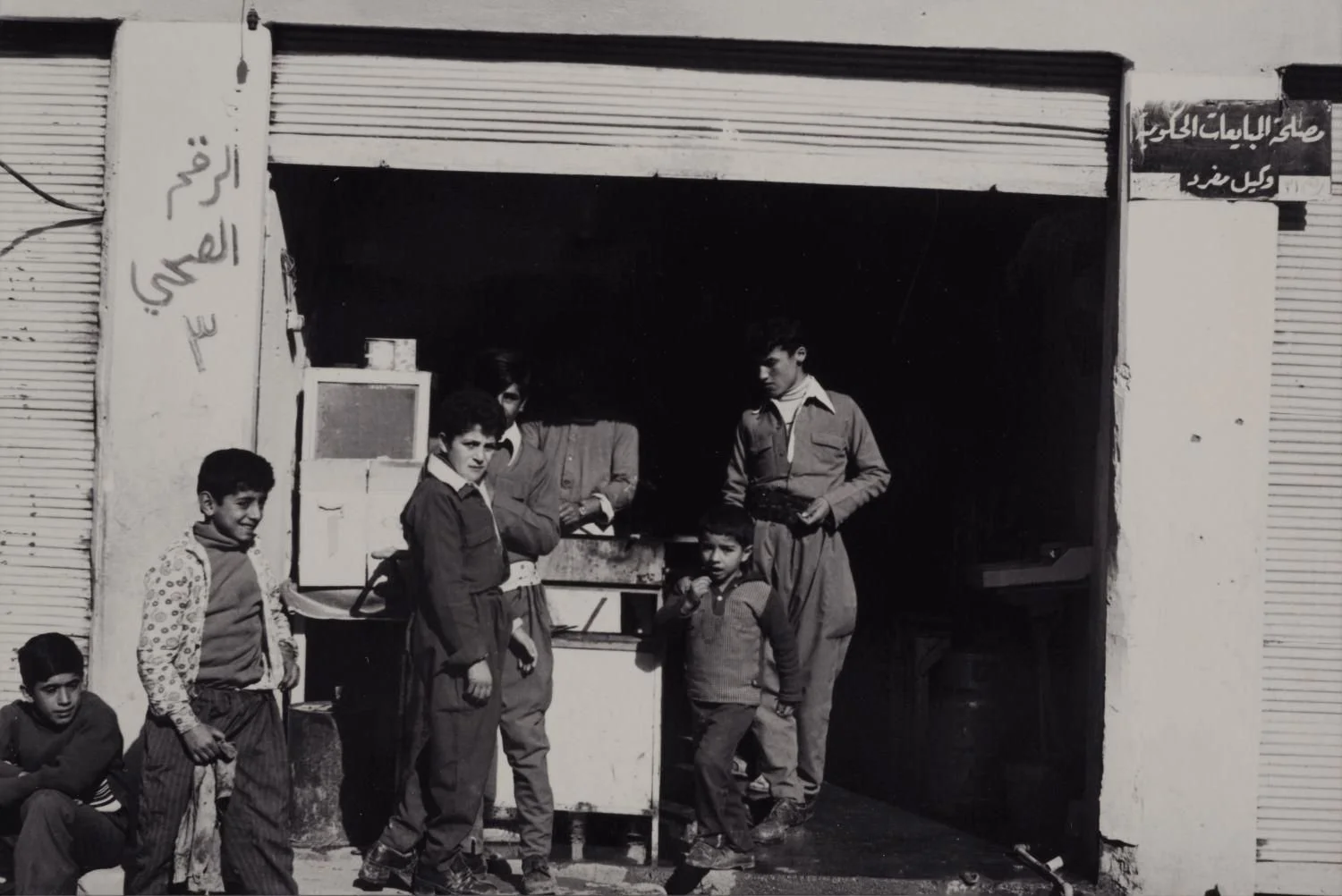
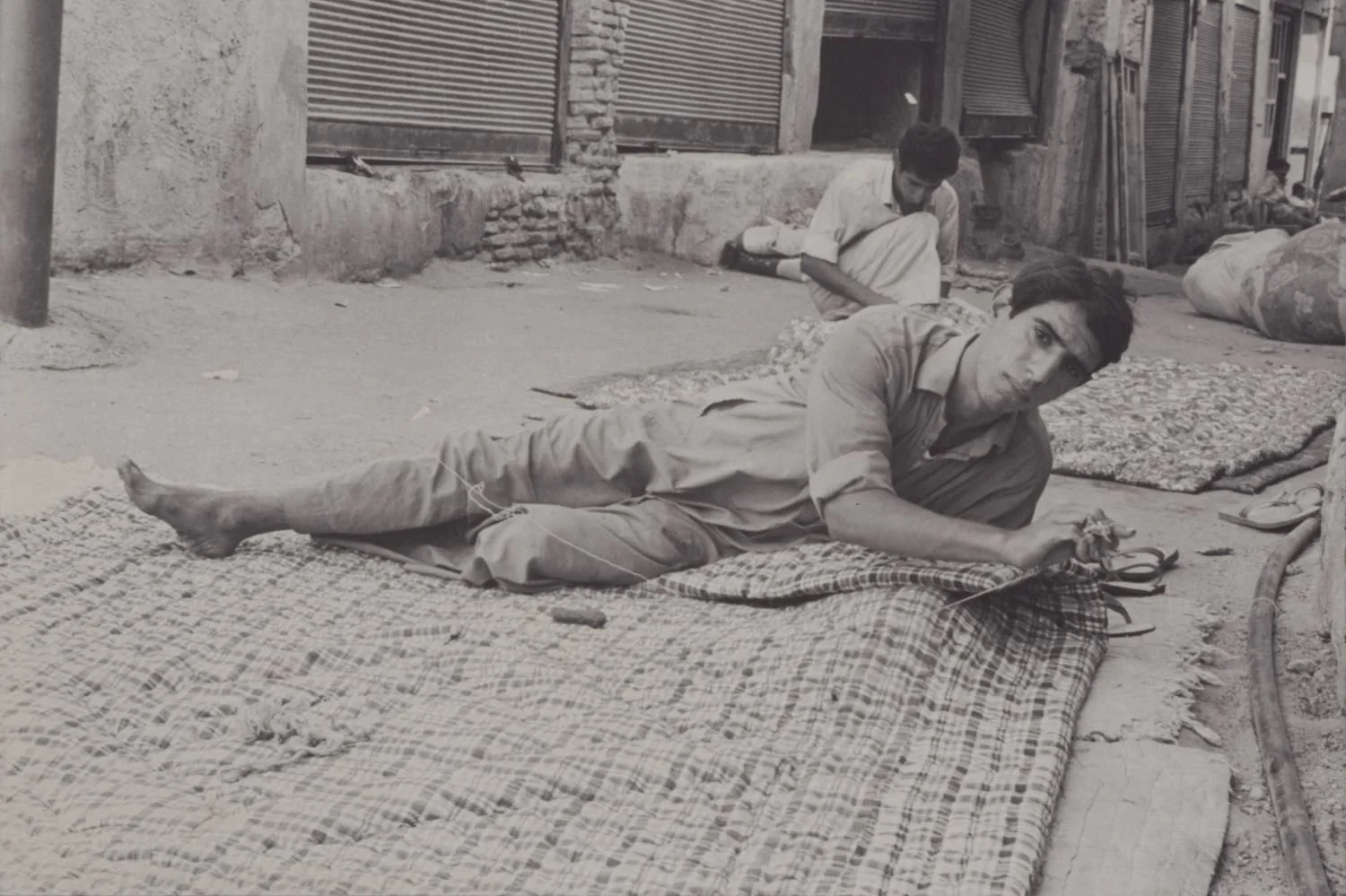
If viewed as a ‘plunge’ into a field of social relations, then Chadirji’s photographic surveys of public life cement a universe of investigation that is so specific, so imagined and executed, that the praxis of architecture must bleed into the events depicted – café culture’s seating arrangements, the activity of table games, forms of transportation such as carriages, automobiles, the workshops to produce traditional carriages, bikes, petition writers with temporary structures outside the courts of Baghdad, shoe shiners on the corners of the capital, water supply mechanisms across rural and urban contexts, demolitions, public squares in Thawra City (Sadr City, Baghdad). (FIGS.24-43). Perhaps, the photographic archive resisted a form of monolithic representation in its vastness yet sincerity. The core of the archive is indeed the evocation of a field of social relations, and to witness how people integrate into the city’s arteries in constant motion, debate, and vigilance.
THE ADVENT OF ASSOCIATIONS: MATERIAL INTEGRITY
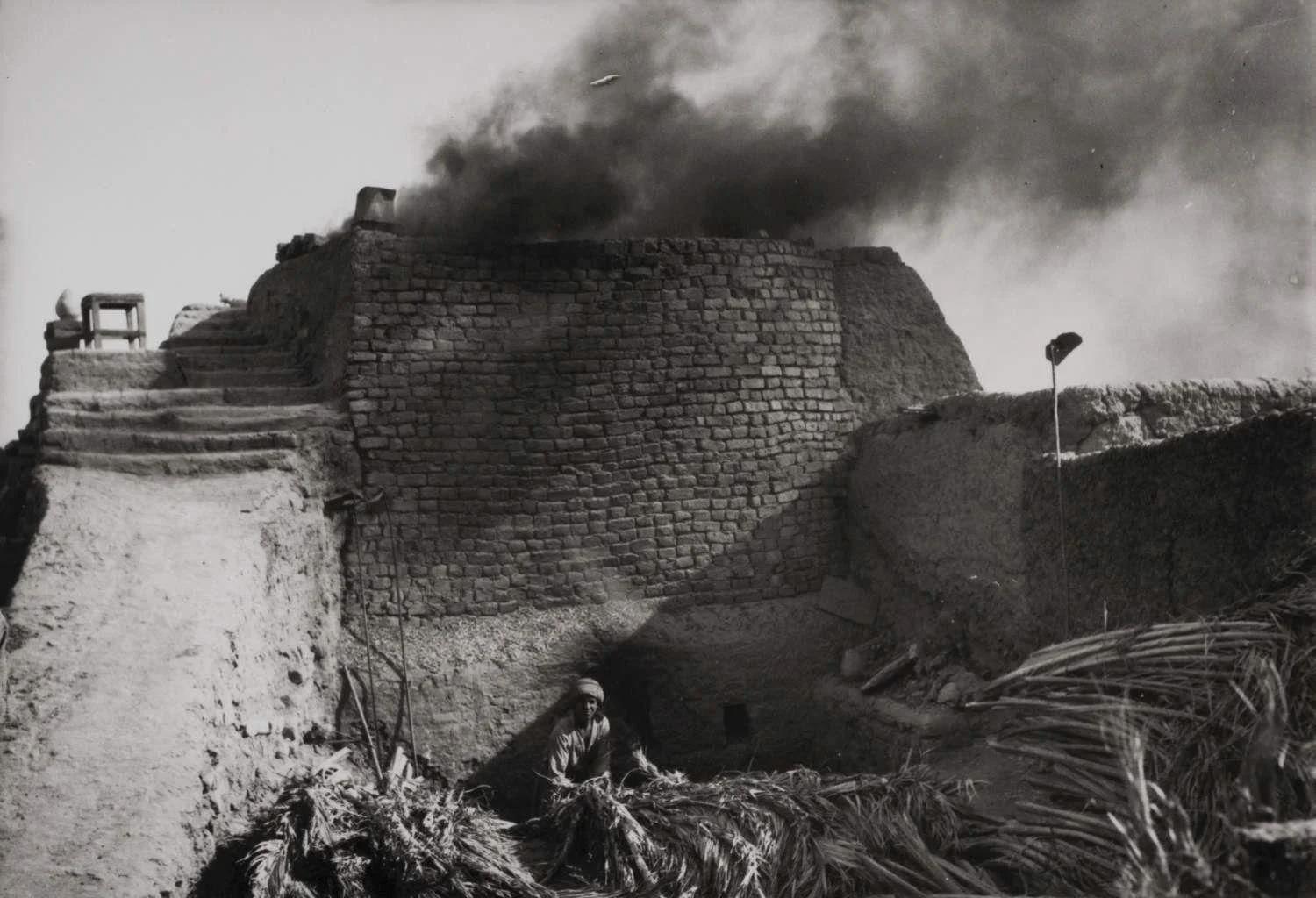
When considering Chadirji’s structures such as the Tobacco Monopoly Headquarters (1965-67), one can verify the advent of his outward projection of traditional architecture in monumental fortress form, with brick work elevating it to a mirage of brutalist features (although never included within that canon), arched windows and columns parallel to a broad interior which prioritizes wide open spaces (FIG.44). Concurrently, Chadirji’s photographic representations of the brick industry (FIG.42) solidify a conscious, deliberate choice to cement the realities of production, producing a longevity and cord from the means of production to the final implementation within the building itself.
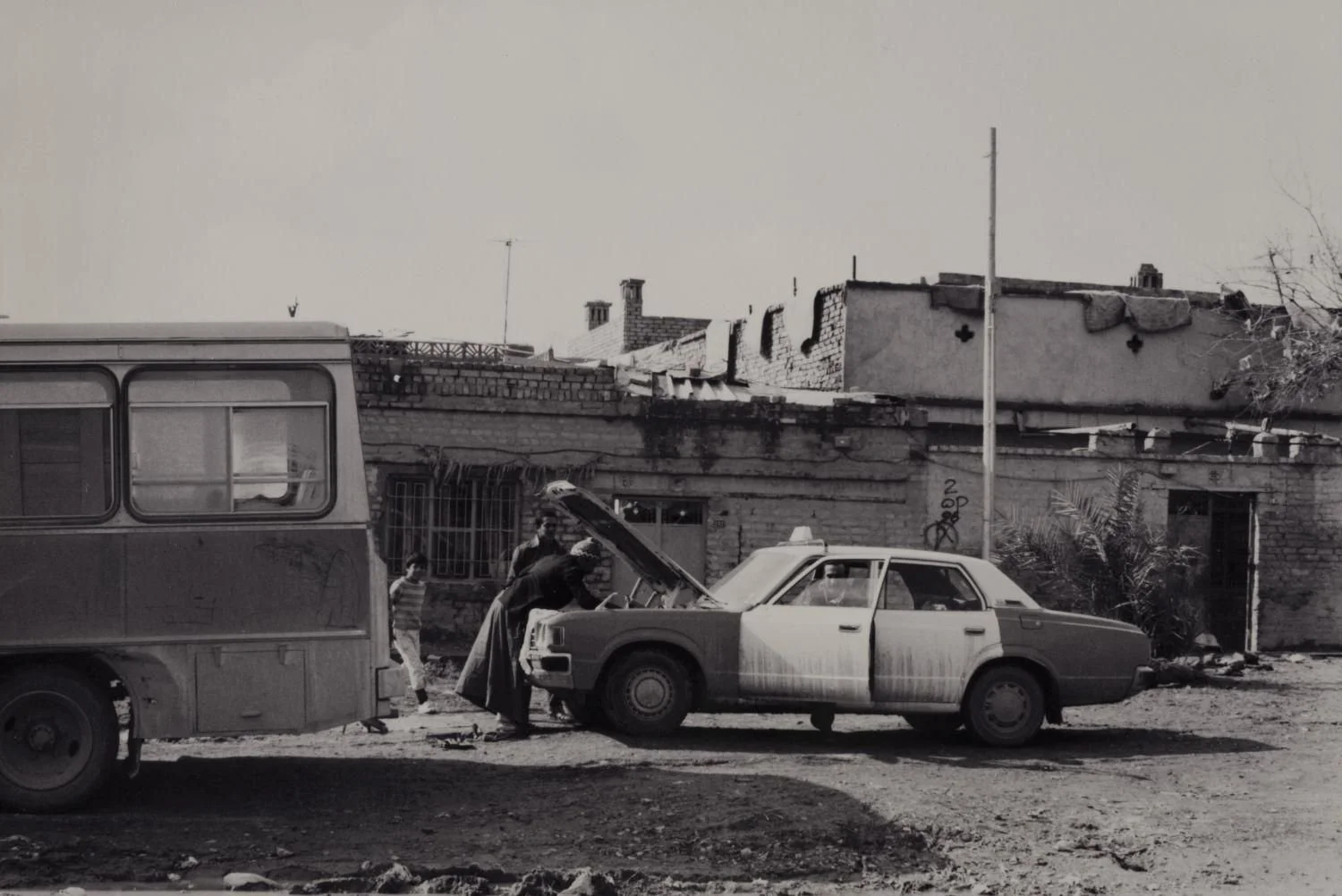
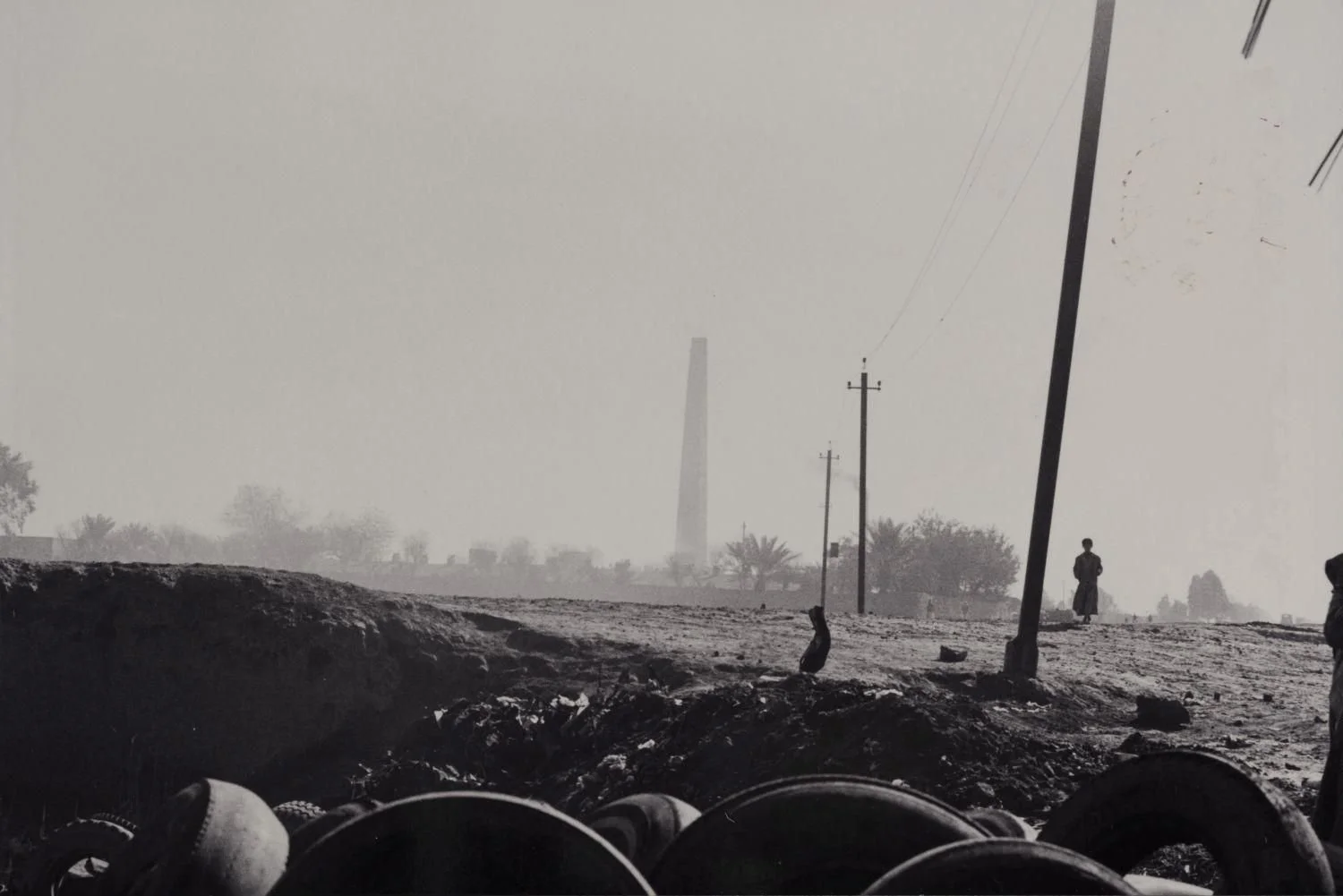
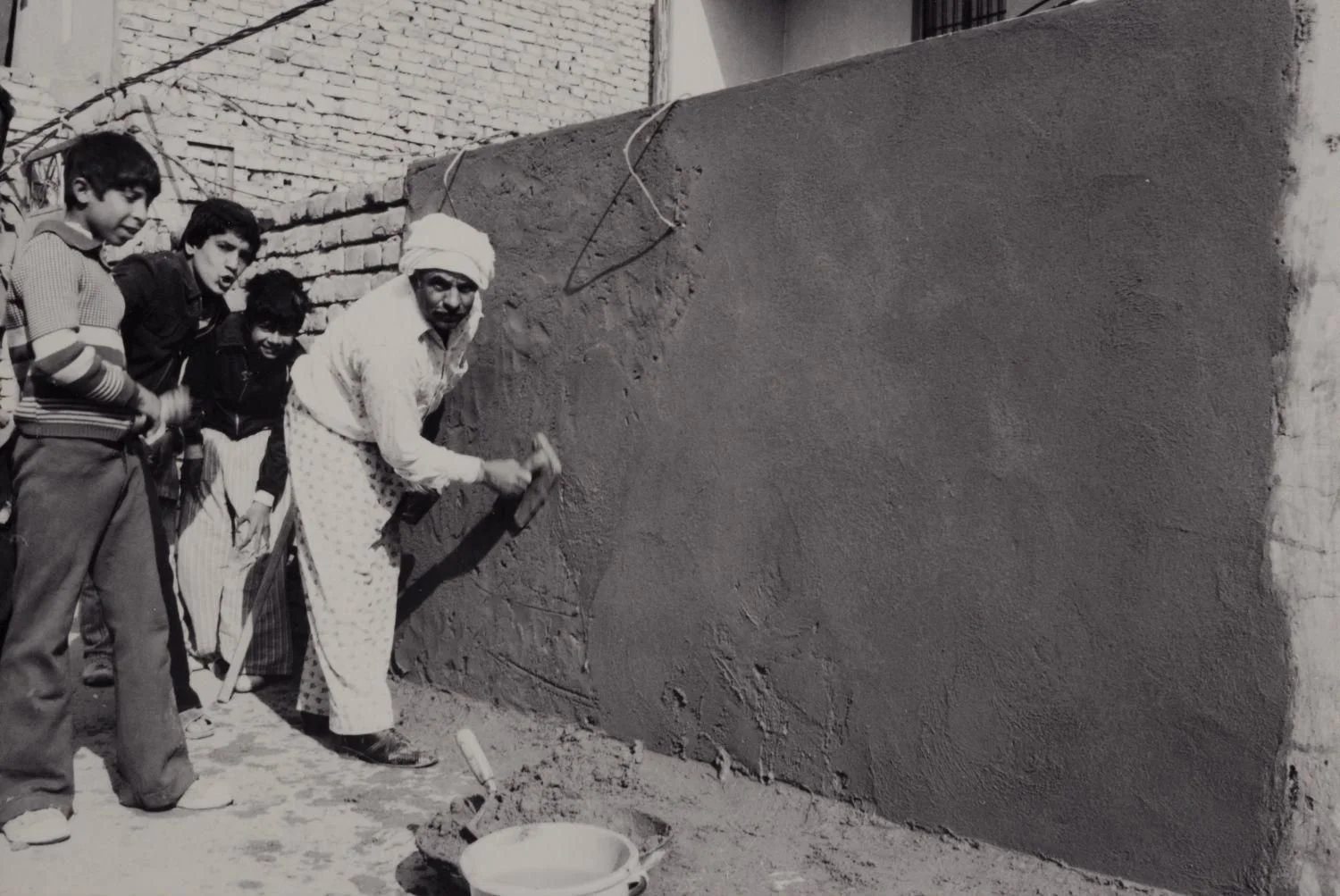
ON THE INTEGRITY OF MATERIAL
In Chadfirji’s words, people are never far removed from the material itself, and the photographs provide a proof of ‘cybernetic interaction’ that solidifies an ethic of virtue:
“The processing of materials is primarily a function of the natural properties of the materials themselves. Man acts as a catalyst or a complementary force in the making of tof, for example, or the baking of terra-cotta, the weathering of sheared lumber or the setting of concrete. His actions and the changes they produce in the raw materials are interdependent in a process of continuous cybernetic interaction.”
Within the archive, the large smoke funnels and kilns are shown with figures navigating this desert-ridden landscape. In his respective depictions of Baghdad’s residential architecture, the arched brickwork of a door is rendered (FIG. 45), and one begs to question if coincidences such as this produce an archive of recognition that was to then fortify his architectural developments (FIG. 46) with a sincerity and gesture responding to his surroundings, as a witness and translator.
The integration of a specific code of circulation, industrial apparatus, storage units, and communication/offices are integrated alongside an interior courtyard which elicits a propositioning of domestic and religious structures, projecting an industrial building into a legion of its own, an independence of spirit that characterizes so many of Chadirji’s evocations. The mediums which he employed to depict such projects, etchings, sketches, and the photographic medium rendered the vision across materialities, enriching and non-surrending to one specific mode of representation. For, it becomes a means to engender the real from the once invisible.
These trades that Chadirji negotiated as a value of representation provided the lifeblood of an economy that bled out into the streets and cultural longevity of trade.
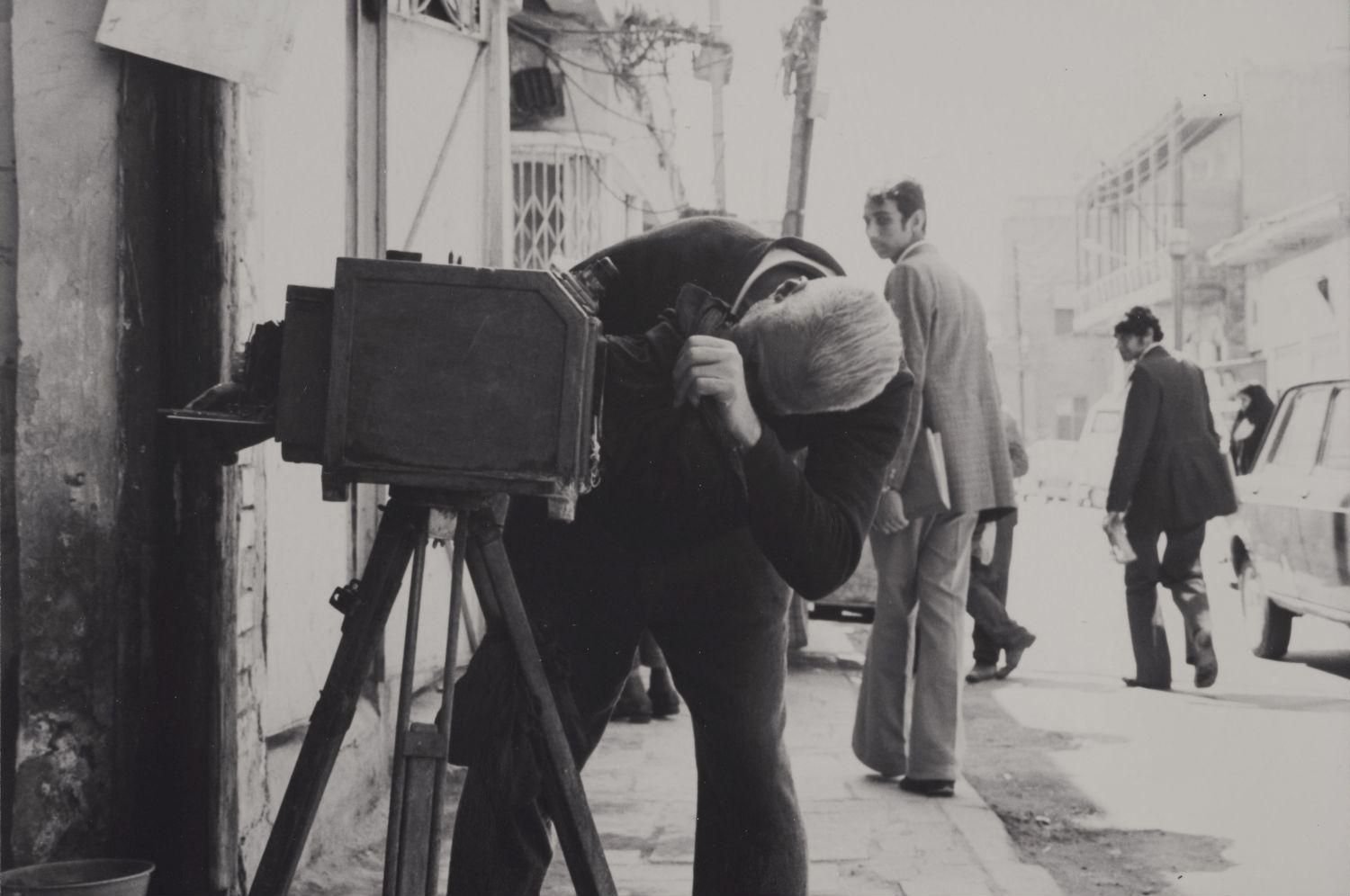
NEGOTIATING THE MONUMENTAL
Chadirji’s extensive photographic survey representing political advertisements provides a visual treatise on the infrastructure and application of media within the built environment – projected as mobile monuments within demonstrations, across vertical interventions in automobiles, and applied to walls and corridors. When in 1959 the new leader of the Iraqi Republic, Brigadier General Abd al-Karim Qasim commissioned a monument (Nasb al-Hurriyah, Monument of Freedom) with project architect Rifat Chadirji and artist Jewad Selim, a constellation of motives would seek to produce a monument towards Iraq’s declaration of independence, within the central business district above al-Tahrir Square and al-Jumhuriya Bridge. (FIG.47)
Upon the early death of Selim who would never be able to complete the project, a final presentation of the form depicts a scale, width, and height that mirrors the elemental billboard, a form of continuous montage edited with twenty-five bronze figures, combining Arabic characters with Sumerian and Babylonian forms, that instill a motion of contorted bodies on a static, elevated plane. Selim “sought to synthesize concepts gleaned from the international avant-garde with abstract forms derived from tradition.” He called his own approach a “regional, international architecture’ that he claimed excluded replicas of traditional elements.”
Selim’s nephew, the artist Rashad Selim, had credited the work of the Baghdad Modern Art Group for producing an iconographic dialogue with the past, “...starting with the depiction of eyes, more eyes and what eyes! Sumerian statuettes depicting worshippers hold in their wide open gaze the legacy of man questing into the unknown, for significance beyond his essential aloneness within creation. Ruins and dust as well as the geometry of human industry that survives the layered weight of history, in the traditions of popular culture.”
Within the ‘geometry of human industry’ both artists negotiated a form of representation that would oscillate between time and gesture, conflicts of freedom and emancipation in built and artificial forms that would transpire to the real. Through a legacy of immutability, the monument still stands as the surrounding political regimes have sought to destroy it. And if not a monumental billboard, referenced and indexed among the photographic survey the architect kept in his personal archive, then how could one begin to question the existence of that gaze onto such material?
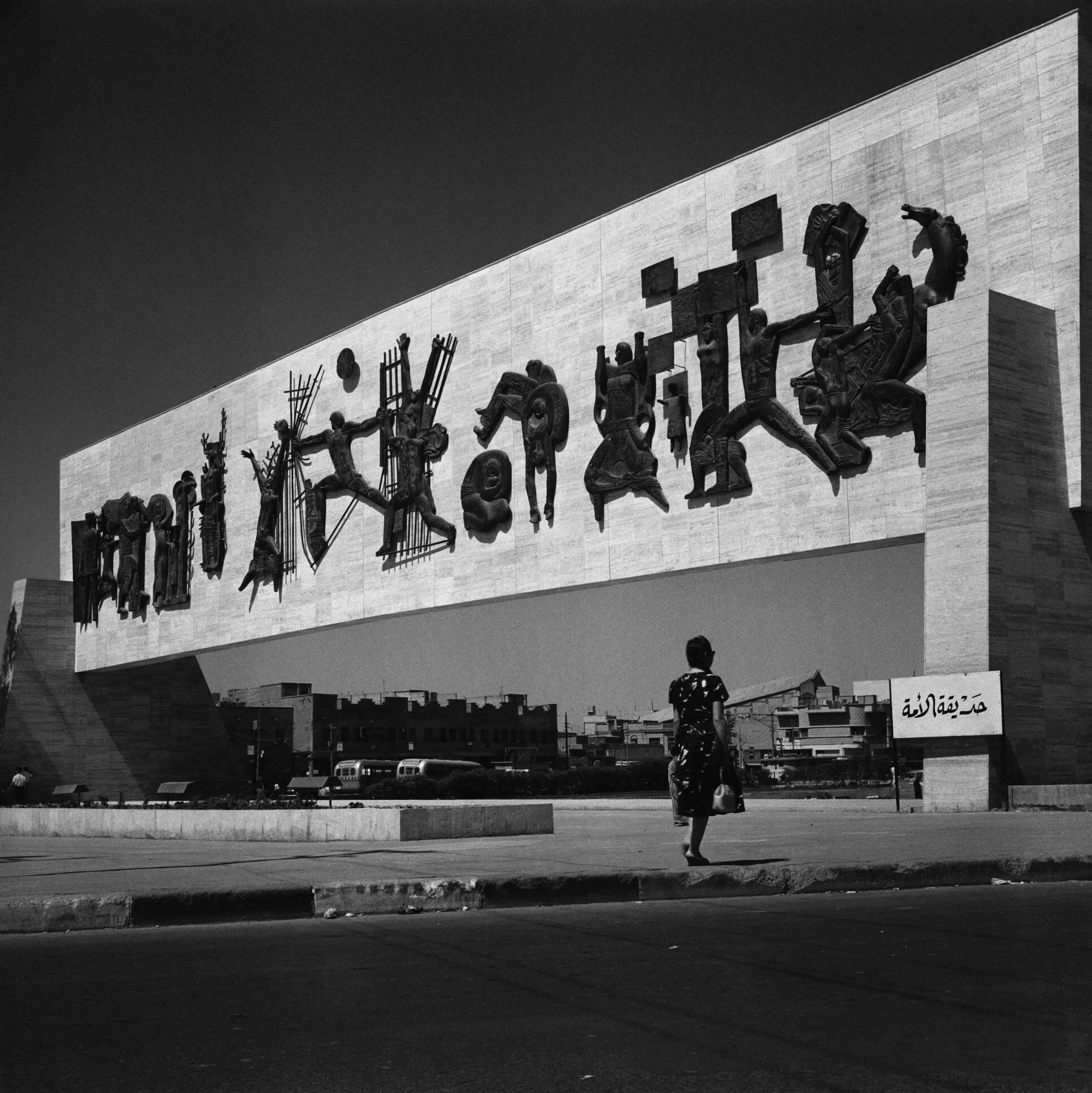
Monument to Freedom, Jewad Selim, Tahrir Square, Baghdad, 1962. Photograph by Latif Al Ani
Foucault laments: “History protects us from historicism—from a historicism that calls on the past to resolve the questions of the present.” The break of modernism provided seemingly ruptures of informational veracity – a pipeline of dismembered agendas under the regime of speed, velocity, and exteriorness. Chadirji’s modernism was not a schism to form a critique of history, but a means to avenge the great error that tradition typically falls under – an inability to evolve without waste of character. So, how did photography engender such a notion of movement? Of future-building? It all remains in the precipice of an enduring gaze. For the seeing figures of Selim are part of the architectural project, not far-removed from the architect Chadirji’s own investigation into the photographic medium as a trapeze into the field of vision that would exclude nothing, building a vision of mediated understanding that still resists.
Selection of Images Respective to Kamil and Rifat: Courtesy of the Kamil and Rifat Chadirji Photographic Archive, Aga Khan Documentation Center, MIT Libraries.
Bibliography
Bernhardsson, Magnus T. “Visions of Iraq: Modernizing the Past in 1950s Baghdad.” In Modernism and the Middle East: Architecture and Politics in the Twentieth Century, edited by Sandy Isenstadt and Kishwar Rizvi, 83–102. Seattle: University of Washington Press, 2008.
Camus, Albert. The Myth of Sisyphus. Translated by Justin O’Brien, with an introduction by James Wood. London: Penguin Books, 2000.
Chadirji, Rifat. Concepts and Influences: Towards a Regionalized International Architecture. Vol. I. London, New York, and Sydney: KPI, 1986.
Damluji, Mona. “‘New Lights for Aladdin’: Utopian Visions, Architectures of Tradition, and the Making of Modern Baghdad, 1950–1970.” Traditional Dwellings and Settlements Review 22, no. 1 (Fall 2010): 74–75. Published by the International Association for the Study of Traditional Environments.
Foucault, Michel. The Foucault Reader. Edited by Paul Rabinow. New York: Pantheon Books, 1984. Originally published as “Space, Knowledge, and Power,” Skyline, March 1982.
Isenstadt, Sandy, and Kishwar Rizvi. “Introduction: Representation.” In Modernism and the Middle East: Architecture and Politics in the Twentieth Century, edited by Sandy Isenstadt and Kishwar Rizvi, 1–29. Seattle: University of Washington Press, 2008.
Kultermann, Udo. “Contemporary Arab Architects and Their Contribution to the Renaissance of Architecture in the Arab States.” Ekistics 47, no. 280 (January/February 1980): 41–44.
Magazachi, Zeina. “In Conversation with Dr Rifat Chadirji.” Round City, April 10, 2021. Interview transcript. Accessed January 7, 2026. https://round-city.com/in-conversation-with-dr-rifat-chadirji/.
Selim, Rashad. “Diaspora, Departure and Remains.” In Strokes of Genius, edited by Maysaloun Faraj, 55. [Publication details unavailable].
Virilio, Paul. The Aesthetics of Disappearance. Translated by Philip Beitchman. New York: Semiotext(e), 1991.