est. 2021
Features & Interviews (21)
Tributaries to form a new grammar – a seismic reading centering practitioners of design, artists, and photographers whose work exemplifies novel horizons.
-
If we begin with the image of faded mirrors, like the tarnished skin of a mulberry tree by the river bed, we sense the sweat of the body exhumed to a dark veneer. We walk the corridors of Torino city towards the River Po’s edge, onwards, shadowing a continuous image of the solitary interior Carlo Mollino set after his death. Athens Design Forum presents the commissioned essay “CARLO MOLLINO. Architettura. Arte e Segreto” a philosophical projection by Fulvio Ferrari, curator of the Museo Casa Mollino in Turin, Italy. Ferrari contends, “The bond that unites architecture and philosophy, two worlds that seemingly have no common ground, is Reason.”
-
The human cognition of finality has long penetrated the world of symbols, reckoning such knowledge a talisman toward creation itself. For the first time, Athens Design Forum and The JB Blunk Estate present a body of imagery associated with the artist's encounters throughout Indonesia, supported through a USICA Cultural Exchange Travel Grant, orienting a horizon through which to question how one becomes a ‘recipient’. Within the act of reception lies the tension between recognition and the creation of new proportions, novel translations.
-
“Drive out the imaginary and it returns at a gallop”
— Michel Butor from Inventory: Essays (1969)
Incantations of machinery, stilled in a photographic frame, summon an abstraction made sensible to the human eye. Produced within the governmental frameworks of the Historic American Buildings Survey (HABS) and the Historic American Engineering Record (HAER), Jet Lowe's photographs continually exceed the documentary mandate from which they emerge.
-
In the ash-soaked images of Chilean filmmaker and photographer Rodrigo Vergara, a critical substance emerges from latent states. Collisions and ruptures permeate seams of reality – doors, roofs, even the hide of a horse, become canonical figures. What is absurd gains a leverage of permanence. Within Pablo Neruda’s ‘Suddenly, A Ballad’ from Memoirs from the Black Island, a novel entity emerges from an ash bed, coercing a sacred effect: “Something is born in the depths of this, that was once ash, and the cup trembles with red wine.”
< Expand >
-
As the camera becomes an inscription of sight, the stage of framing and those depicted requires a delineation of spirit, solidifying a reveal of intention from the latent image. This becomes the alchemy of the darkroom; a value-system of image creation where nothing is certain until the effect of appearance becomes visible.
-
There is a gesture of a fisherman in Fukushima, whose desire to release his net is never stilled in momentum, even though he cannot eat his return of labour due to exposed radiation. The act is what French-German photographer Rebekka Deubner described as a form of forced “preservation” with a changed or obscured finality. The human, in face of change, finds continuum in the defining inscription of their traces.
-
Athens Design Forum presents Cloisonné, a photographic series by Spanish photographer Adrià Cañameras in Beijing, China.
There is a cosmology of partitions that the form of cloisonné permits. With each copper enclosure and distinct line, the potential to emulate the infrastructure of a honeycomb presents itself. Barcelona-born photographer Adrià Cañameras on assignment to document Hotel Xitan in July 2025 within the Mentougou District outside Beijing, met Li Jing, a ceramic artist whose mosaic framed the hotel’s entrance.
-
“After death, time and chronology will be lost in a sphere of symbols.”
from El Hacedor (Dreamtigers), J. L. BorgesThere exists a tone of demarcation, a spirit underserved by the limit of time. In the photographic archive of Lebanese-Danish architect Paolo Barkett, a domestic space is rendered permissible; disassociated from a fixed state, an interior digresses toward a mirage with the known absence of a protagonist. Seals of authorship are soaked in deep, saturated abandon. The light of Nordic starkness surrenders to the image of a woman’s chambers at the moment of perceived regression.
-
a bridge towards the agora
It is the balcony of one mnemonic time.
In the image of an iconostasis rebuilt – where the farmers once plowed, the agora emerged, plot after plot, and the polyphony of their intentions brought forth one, or many, miracles: ones that must be saved. “For us, it is a lifetime,” they say, and the lights dim on the rooftop of this old structure, its cornice weathered. Through the scent of bread and coffee, the market of Kallithea puts to flame a new century into being.
-
“For we are wounded by invisible swords from the blue” – Francisco Garcia Lorca, The Cicada
Where there is a recurring sound of wings in motion, Lorca’s The Cicada deciphers a limit of blue — not as horizon, not as a finality — but a ferment of colour to make legible the “invisible swords”. Perhaps it is the sea or the sky that pacifies in a tone so known that its outline always carries a weight of recognition. Athens Design Forum presents the archive of Georgian interior architect and designer, Eka Papamichail.
< Expand >
-
Within Palazzo Cusani’s Via del Carmine façade in Milan, the wars carved into the stone emerge as the sole decorative feature of the architecture. Ornaments are tools to define relationships; to exploit difference, to create opposition, contrast. They take place in relation to space; specifically, along the action of entering the building or walking by it. They are not perceived in autonomy but in sequence: all the parts of this war-carousel display the strength that this palace wanted to represent.
-
“The pursuit of forms is only a pursuit of time, but if there are no stable forms, there are no forms at all.”¹—Paul Virilio, The Aesthetics of Disappearance
In the wake of archaeological photographic images, we may begin to decipher Paul Virilio’s conception of the sensorial mass: how the stabilized form of an excavated artifact becomes eternalized within the cage of a photograph. If photography functions as a penetrative method to assert an influence of cementation, then the decisions that remain unspoken—placement, framing, repetition—are prolonged in time. In this stillness, a series of anomalies accumulate.
< Expand >
-
Athens Design Forum presents Lebanese artist Ayla Hibri’s chain of thematic photographic essays—Toys, Metal Welders, and Dreamers. In their three-fold partition, the essays relay the transgression of matter into the praxis of authorship. Across the territories of Jordan, Eritrea, and beyond, Hibri navigates the thresholds between the particular and the universal, always attentive to laws of patterns and the acts of once undefined rituals.
-
Athens Design Forum presents Argentinian photographer and director Francisco Canton’s series, Offset, a penetrative entry into the forensic rhythm between frames. "The choreography of these images arises from a limit I impose on myself," Canton notes, "using timing and sequence to create a rhythm and sense of continuity in the work." Repetition reveals rupture and familiarity becomes estrangement, evolving forward in the innocuous presence of a metronome.
-
When the mind proliferates images of accord, and designers form the enunciabilities of a nation, the archive is burnished to a dimension bound in static proportion. The velocity and range of a country’s aesthetic regime is articulated in the power of graphic form, surpassing solely the built, concentrated in the mobile projections – record covers, magazines, catalogues, books. Forging a timeline vulnerable to erosion, Venezuelan graphic designer Ricardo Báez formatted a potent repository, Archivo Gráfico™ Venezuela, enabling introspection into types of corporate sponsorship routinely tied to oil extraction, such as El Farol magazine.
-
Athens Design Forum presents ‘SALON PHILIPPE’, an interview conceptualized by Lebanese designer Youssef Bassil on the fractal identity of a barbershop (est. 1968) in Achrafieh, Lebanon. An anatomy of the interior works in material counterpoint, affixed by years of quiet fortitude – the original Lebanese-made cast iron barberchairs, chrome-dipped and baptised with a signage of ‘Venus’, are reflected in the softness of formica walls and melamine counters. In Bassil’s composition, an anthology of belonging traces the disappearance of citrus trees and grape vines as the city center of Lebanon ever-rises in the portrait of Philippe Aaoun, ‘SALON PHILIPPE’.
-
“Revisiting the figure of the pirquinero allowed me to explore a specific form of resistance—one that continues to express itself through exclusion.” – Javier Aravena Costa
Athens Design Forum presents Escombros and La Memoria de la Forma by Chilean researcher and photographer Javier Aravena Costa. When extraction is articulated as a symptom of industrial annunciation, architectural permanence is dismantled. In the absorption of a geography’s lack or abundance, Costa deciphers the conscious alternation of landscape and how ‘new contexts of resistance’ inform the forging of territorial identity.
Within Escombros (debris), the pirquinero (small-scale miner) embodies a legacy of pre-Hispanic mining in northern Chile.
-
Athens Design Forum invites Egyptian photographer Mariam El Gendy for an in-depth feature on her personal observations – a sensory continuum where architectural structures wrought with visible labor systems, born out of improvisation, become central protagonists. In an anthropological and deeply critical approach, El Gendy deciphers a longitude of belonging where she discerns, “I’ve always felt that when a subject engages with their surroundings, they shape the image themselves.” Across sites such as playgrounds, parks, urban highways, markets, and clinics – we witness Egypt’s transcending pulse and a means to reconcile with the bridge of instinct.
-
In the lasting images of Argentine sculptor Luna Paiva, one senses the artisan’s relationship with landscapes of movement and the immateriality of a gesture shared amongst youth. Athens Design Forum invites Paiva to share a dialogue and photo essay on the choreography of play; how she imagined a sculptural playground for an orphanage in Amizmiz, Morocco, once the epicenter of the earthquake, in a collective effort towards reconstruction.
-
Athens Design Forum (ADF) steps quietly into a new season with a lucid typographic identity: Kolonia, a typeface designed by Dominik Bissem, a graduate of ECAL’s Master’s program in Type Design (2023).
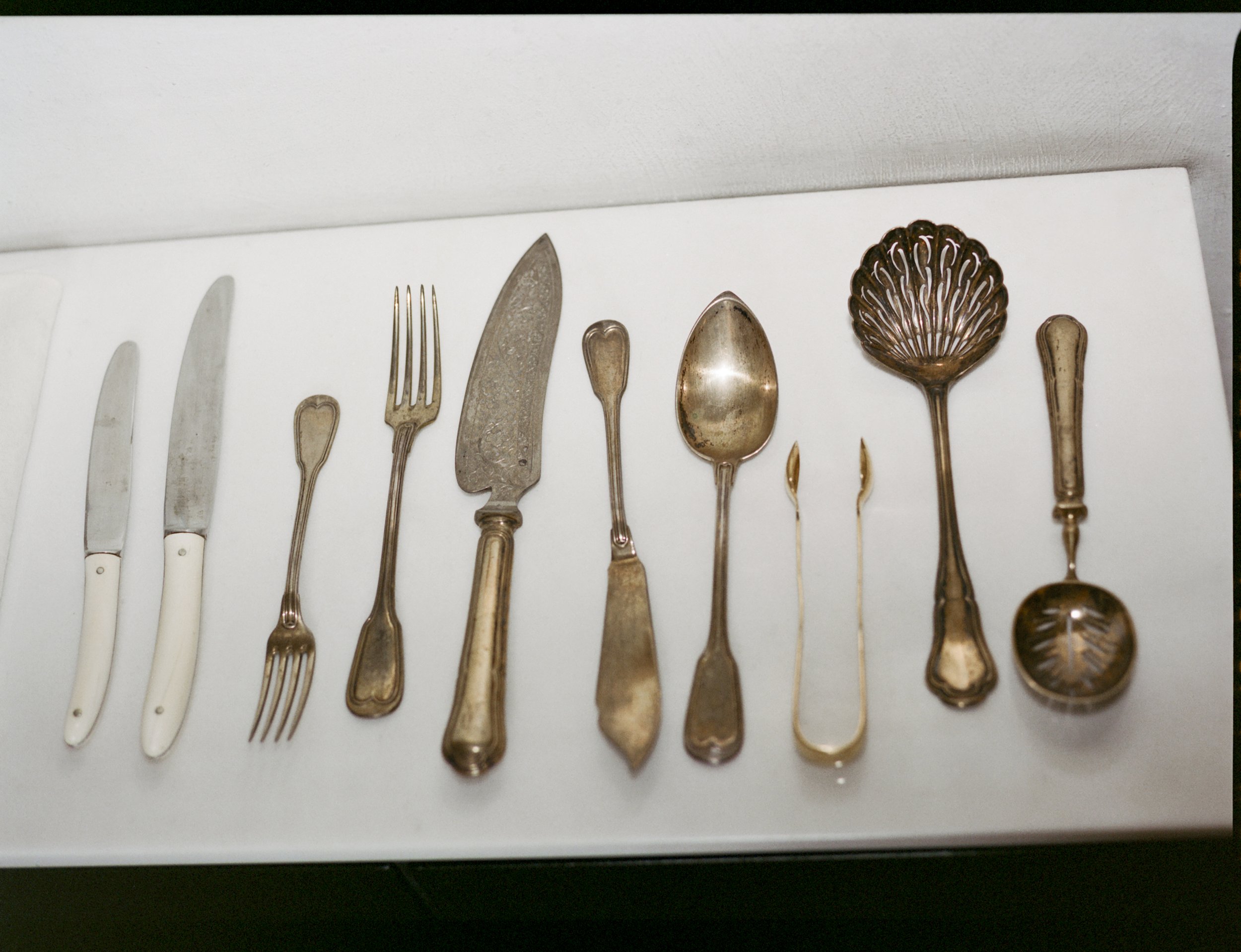
‘The Skin of River Po, Carlo Mollino’ with Fulvio Ferrari and Andrés Altamirano
-
Athens Design Forum presents a selection from Greek-Lebanese artist Georges Salameh’s WHITE MIDDLE SEA (ongoing since 2010).
Salameh discerns: “The Mediterranean Sea (المتوسط الأبيض البحر - the White Middle Sea in Arabic) is the geological and intangible heritage of all identity sedimentations. Open basin or cosmopolitan diversity, graveyard to three continents, Africa, Asia, and Europe.”A conversation follows with Athens Design Forum founder, Katerina Papanikolopoulos and Georges Salameh.
-
In Levenson’s prefix within A Sense of The Earth, the city and built structure are dismantled in terms of natural materials, with origins that surpass the visible eye. He asks us to redeem extraction as a method of acknowledging the naturalness preserved around us, albeit in its haunting, imposing forms.
Portrait of a Space - Kozani harnesses the depths of Levenson’s lament and one meets the projections of memory onto place. Athens Design Forum invites photographer Yannis Drakoulidis to encounter the landscapes of his grandmother’s home in Kozani, Greece. In an exterior photograph, red geraniums in the shade of concrete columns are affixed by the speed of a passing car.
-
There is a conscious thread that ties man to his son, and within the nexus of a craftsman, these traits and intricacies of identity become submerged in the translation of one’s knowledge to the other. Miltiadis II Vithoulkas, a name derived from the Greek word for “red earth” sits with his son, George II Vithoulkas, a name imbued with the earth,“earthworker.” I meet both men in their restoration atelier and antique store on Erechtheiou Street (est. 1987 – Athens), and while savoring sweet liqueur, we unveil their ethos of furniture making and restoration, a tale of makers whose embodiment of their craft evinces the pleasure of giving.
This previously unseen archive is now digitized with the support of Athens Design Forum.
-
In the cosmology of lace, the fortitude and diasporic identity of Armenians is present.
As if the threaded constellations are joined in an impermeable dance, the action of intent remains in engaged connection. Athens Design Forum speaks with curator Gassia Armenian on the conscious cultural multiplicity of lacemaking, and the spirit that arises from a craft where fingers and thread pulsate forward intricate webs of meaning.
-
“Our environment is deeply connected from the soil and dust to the flowers and ash to the very alive inanimate forms produced from the land…” Dima Srouji – October 31, 2023
Athens Design Forum resurfaces archival material sourced from the G. Eric and Edith Matson Photograph Collection, found in preparation for our 2022 collaboration with Palestinian designer Dima Srouji presenting ‘Phoenician Pigeons’ in Brussels, Belgium. This collaboration spearheaded Palestinian-Greek cultural relations through the inaugural showcase of their collective glass histories.
-
In a world of infinite circumstances, few believe in the multiplicity of form – or seek to philosophize concepts of matter that have been routinely displaced of their mystery. Miguel Leiro is amongst those who walk in the passage of the sacred and the profane, a man of contemporary dimensions.
-
Athens Design Forum speaks with Palestinian designer Dima Srouji following the 2022 six-year retrospective of Hollow Forms and our presentation of Phoenician Pigeons in Brussels, Belgium. Papanikolopoulos and Srouji uncover images and narratives of resistance enveloped by the praxis of craftsmanship – from shared meals with artisans in Jaba’ to the longevity and palimpsest ecosystem of glass production.

The Dialectic of Film (12)
Athens Design Forum’s curatorial programming prioritizes film and photography as integral, critical methodologies to decipher design’s social role. The medium of film acts as a space for re-inscription.
-
In the lexicon of images, a silence grows that submerges one frame into the other. Athens Design Forum presents an interview with directors Nicolas Graux and Truong Minh Quy of Hair, Paper, Water…, after the London premiere of the film at the Institute of Contemporary Arts. Saigon’s labyrinthine system of buildings and infrastructure evokes a mediated artifice to the protagonist Cao Thi Hau’s known world, born in a cave within the Ruc community of Vietnam. The film’s structure of reference becomes the Ruc language, a ‘spine’ to elementally build associations. A sonic axis creates an integral emotional continuity to soften the ephemerality of a Bolex camera’s vocal remoteness. As Truong Minh denotes, “The form of the film is partly what is not named. For me, a film is also what is absent.” Disappearance is rendered immovable as the natural world is encountered through words (mother’s milk, fire, cave, water…) – surmounting a vocabulary of recognition that is as percussive yet fragile as the ecosystem of the human condition.
-
For Milan Design Week 2025, Athens Design Forum presents a screening of Tomka dhe shokët e tij (Tomka and His Friends) by director Xhanfise Keko (Albania, 1929–2007), hosted by Dropcity Center for Architecture and Design.
On the banks and in the whirlpools of Osum River, arteries of retaliation coalesce and forge, forming the legacy of Tomka and His Friends by Albanian Director Xhanfise Keko. With a pressing score by Aleksandër Lalo, the narrative is woven with fervor and a claim to nationhood that surpasses merely the cinematographic. The senses are foremost a symbol of youth and resistance expressed through four best friends: Tomka, Çelo, Vaska, and Gëzim.
-
In the closing sequence of Tomka and His Friends (1977), the Albanian village of Berat is deciphered solely in the night through the Ottoman windows, shown through the ignition of lanterns that come to frame the city's awakening. The legacy of Albania’s renowned director Xhanfise Keko rests on the shoulders of this ending. Athens Design Forum invites Genc Permeti of Ska-Ndal Productions—producer, screenwriter, and advocate of Albanian cinema—for an exclusive interview in homage to featuring Tomka and His Friends (1977) by Xhanfise Keko for Milan Design Week 2025 at Dropcity Center for Architecture and Design. The film’s enduring language and intentional engagements with architectural discourse are embodied in Keko’s reflection, “It is no coincidence that resistance unfolds in the few places collectively owned by the city's inhabitants.”
-
Athens Design Forum presents the early documentaries of Mexican Director Juan Pablo González: The Solitude of Memory (2014) and Caballerango (2018). Juan Pablo González returns to his place of birth within the agricultural communities of Jalisco, Mexico, forming a gesture of re-recognition. Quotidian landscapes – barbershops, butcher shops, nail salons – alongside dense agricultural plots, become the sites where a community of sowers come to mourn the death by suicide of Nando, a horse wrangler’s son. Bereft of their land, they form a wound of resistance that grows and crusts over. The Solitude of Memory, a precursor to the feature documentary film, Caballerango, centers on the protagonist José, Nando’s father, and the last words he said to his son.
-
The primal bend and curvature of Nemércka, a mountain cordillera spanning the border between Albania and Greece, resembles a sleeping woman. Avrilios Karakostas surrenders to the complex origin of this image in his debut short film Nemércka (13”, 2016). In the film, the mountain transforms into an axis where the polyphonic laments of the region are soldered and materialized. As Karakostas contends, “Throughout the film, death functions as a constant, while life is a continuous form of movement.”
-
Where there is a valley of roads, and the individual becomes a scale of the masses, a city unfolds to show itself. This phenomenon, so uniquely hidden, is revealed in Hicham Gardaf’s testament to film as a conduit of the senses. The spectator surrenders to see what has been obstructed at the core of industry and commerce. In Praise of Slowness (Hicham Gardaf, 2023) harnesses sight to elongate movement. The sounds of Tangier pace urgently and yet slowly, defining the protagonist’s vocal and physical trade of selling bleach. Gardaf writes:
“The ears / tell the eyes / where to look / the feet / follow / the sound / from the center / of the puzzling labyrinth”
Athens Design Forum and co-curator Isabella Barkett present THE ECHO OF THE FEAST THAT CALLS ME, a double-screening of Hicham Gardaf's In Praise of Slowness (2023)andIzza Genini’s Aïta (1988) on the occasion of Milan Design Week 2024.
-
Athens Design Forum and Isabella Barkett present ‘THE ECHO OF THE FEAST THAT CALLS ME’, a double-screening of Izza Genini’s Aïta (1988, 26’) and Hicham Gardaf’s In Praise of Slowness (2023, 17’).
Gardaf’s In Praise of Slowness identifies the thresholds of design implications, expounded upon the body. The culture of the bleach sellers in Tangier, Morocco, is shared through a meditation on the morphology of the urban landscape. Space unfolds to witness time at the lapse of tradition. Through the peripheral coexistence of forms – sonic, bodily, and artifact – Gardaf explores the lasting demise of a capricious market.
Sonic landscapes form a central inquiry towards identifying social hierarchies of power — from the bleach seller’s occupation of public space through his laments, and Genini’s ritualistic approach to cheikhate’s collective call.
The aforementioned programming marks the first time the films will be shown in Milan. With extended gratitude to DOPO? Cultural Space @dopo.space and Clara Zevi.
-
Athens Design Forum (ADF) presents the premiere of India-based Yugantar Collective’s filmography in Greece with a double screening of the restored Tambaku Chaakila Oob Ali (Tobacco Embers, 1982) and Sudesha (1983). The films extend ADF’s 2023-2024 ANTHROPOS-TOPOS theme, deciphering how humans coexist with places at the proxy of design.
Tobacco Embers and Sudesha are resonant and emotive examples of how film deciphers the contours and shadows of women’s lives, revealing a potent image. Solidifying its position among the canon of ‘factory films,’ Tobacco Embers’ cinematographic emphasis on portals, doors, and gates alludes to the very structure of how systems of exploitation persist. The films chronicle converging themes of labor practices in environments that span from a tobacco factory in Tobacco Embers to a Himalayan forest in Sudesha. Gendered connotations of labor are heightened and perforated as Yugantar Collective introduces a collaborative process of filmmaking that ensures the voices and actions of the female laborers still resonate today. Since their creation, the films have been screened throughout India in universities and female-led union spaces to harness temporal platforms of critical dialogues.
-
Athens Design Forum is pleased to present an inaugural collaboration with Shasha Movies, the independent streaming service for South-West Asian and North African cinema. Co-curating a selection of five films from the February program of Revolt Against the Sun, the following selection emphasizes contemporary Iraqi video art produced between 2017-2022.
Rooting our program within Athens, the screening will finish with the work of Cypriot artist Marina Xenofontos, Sunlight Vandalism,represented by Athens-based Hot Wheels Gallery. The film deciphers the history of a Kurdish woman’s relation to private and adopted spaces across her migration, revisiting the concept of home.
-
Athens Design Forum presents a curation of films for Cinema Parentesi at BASE Milano, accompanying our 2023-24 theme ‘ANTHROPOS-TOPOS’, deciphering how humans and places coexist at the proxy of design. Mohamed Khan’s El Batikha (1972, Egypt) is followed by Marta Rodríguez and Jorge Silva’s documentary Chircales (1966-71, Colombia). Athens Design Forum’s cross-cultural programming transforms these films into archives of labor practices that examine how design informs labor rights advocacy. The selection emphasizes a diverse spectrum of labor sharing a temporal framework: from an Egyptian office worker in Cairo to a Colombian family of brickmakers, we bear witness to the role of spatial landscapes both as agents of demise and ones capable of intrinsic power.
-
Athens Design Forum is pleased to present a rare screening of Gloria Olivae (1987) by Greek filmmaker Menelaos Karamaghiolis. The upcoming ADF season will investigate global design cultures through images and film archives of labor processes, collectively placing the complex choreography of making into a new, human-centric dialogue.
As our inaugural screening debut, Gloria Olivae is testimony to the craft of man amidst the idolization and consequent exhaustion of fertile cultural landscapes. Featuring documentary coverage of shipbuilders, olive press laborers (amongst other craftsmen), while safeguarding folk songs of the island, the film was described by M. Papadopoulou of the newspaper “TA NEA” (November, 1987) as a “requiem for a disappearing Greece.” Gloria Olivae enforces a memory of place that further reflects the mirroring challenges of our current era – seeing design elements and the community surrounding built structure as protagonists in the transformation of our environments. -
Commissioned by Athens Design Forum to inaugurate the 2021 events – a portrait of a city engulfed in a mercurial fragrance with urban dichotomies.
Exhibitions & Events (16)
Built from the inaugural events in Athens extending to satellite curations of architecture and design
-
Athens Design Forum is pleased to present ROUTE-IN, a site-specific outdoor installation by Tbilisi-based Rooms Studio [est. 2007] commissioned for 5VIE Design Week. Hosted in the historic Milanese SIAM 1838 Courtyard, ROUTE-IN is a progression of Rooms Studio’s research into public space as a central axis of society.
-
Athens Design Forum is pleased to present Phoenician Pigeons, a new collection amongst the first retrospective of Hollow Forms [est. 2016] by Palestinian designer Dima Srouji.
This collaboration spearheads Palestinian-Greek cultural relations through the inaugural showcase of their collective glass histories.
-
Athens Design Forum & Les Ateliers Courbet are pleased to present an Online Viewing Room of Peter Speliopoulos’ CHTHONIC for 5VIE Design Week. Evoking a visual language strengthened by the primordial gods of the ancient Greek underworld, the symbolic pieces transform into archetypes of renewal.
-
-
ADF’s 2021 inaugural programming shaped 12 events in 7 Athenian neighborhoods – broadening the international recognition of contemporary Athens through a cultural narrative axis.