JB BLUNK.
THE PHOTOGRAPHIC GESTURE
Indonesia, 1979
“Everything is already known. We just haven’t seen it yet, haven’t recognized it yet. And it doesn’t have anything to do with time.”
– JB Blunk. Interview with Rita Lawrence, conducted during the opening of JB Blunk Sculptures, 1952–1977. Craft and Folk Art Museum, Los Angeles, 1978.
“A leaf a gourd a shell a net a bag a sling a sack a bottle a pot a box a container. A holder. A recipient.”
– Ursula K. Le Guin, "The Carrier Bag Theory of Fiction." In Dancing at the Edge of the World: Thoughts on Words, Women, Places. New York: Grove Press, 1989.
The human cognition of finality has long penetrated the world of symbols, reckoning such knowledge a talisman toward creation itself. For the first time, Athens Design Forum and The JB Blunk Estate present a body of imagery associated with the artist's encounters throughout Indonesia, supported through a USICA Cultural Exchange Travel Grant, orienting a horizon through which to question how one becomes a ‘recipient’. Within the act of reception lies the tension between recognition and the creation of new proportions, novel translations. As Ursula Le Guin contends in The Carrier Bag Theory of Fiction—an author represented in Blunk’s personal library—“the first cultural device was probably a recipient.” Blunk’s quest toward the manifestation of the ‘recognizable’ may be deciphered through his transfiguration of woven symbols that recur throughout the photographic language he assembled.
In Eastern Sumbanese death rituals, textiles enshroud the deceased body, performing a spiritual weight of enclosure. This act offers a prism through which to consider a Chinese dowry chest, opened at the Inverness Estate after JB Blunk's death. A new key with local artist Kelson Iasiello had to be constructed from an impression of the extant lock, creating an entry into what had remained sealed. His daughter Mariah Nielson, director of the JB Blunk Estate, encountered a ritual of his own dimensions: textiles from East Sumba, Peru, and Mexico embraced a selection of his own favorite creations – amongst them, a bowl, a few plates, and a ceramic sculptural piece.
When Blunk affirms to Rita Lawrence that “all the essence is already in existence,” the cosmological gestures he documented across East Sumbanese textiles enter into dialogue with the artist’s own meditations on origins and spirituality. For, it is known that Blunk himself had a weaving practice in Inverness, CA, among his constellation of tactile expressions. Through their photographic mediation, these textiles can be imagined as vessels and holders of embodied knowledge, their woven inscriptions entering into dialogue with the fingerprints Blunk incorporated across ceramics, stone, ink, and wood as traces of human presence.
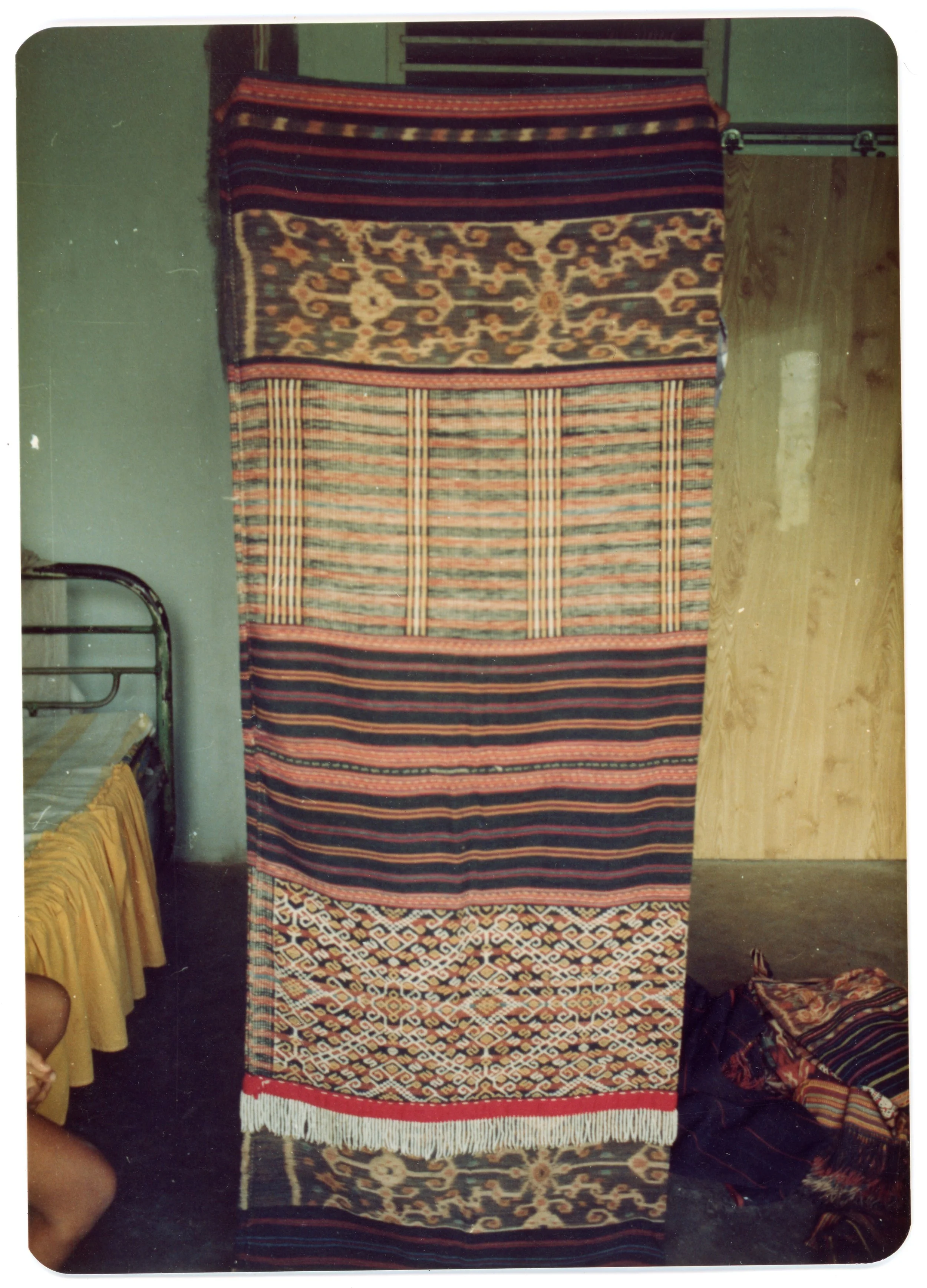
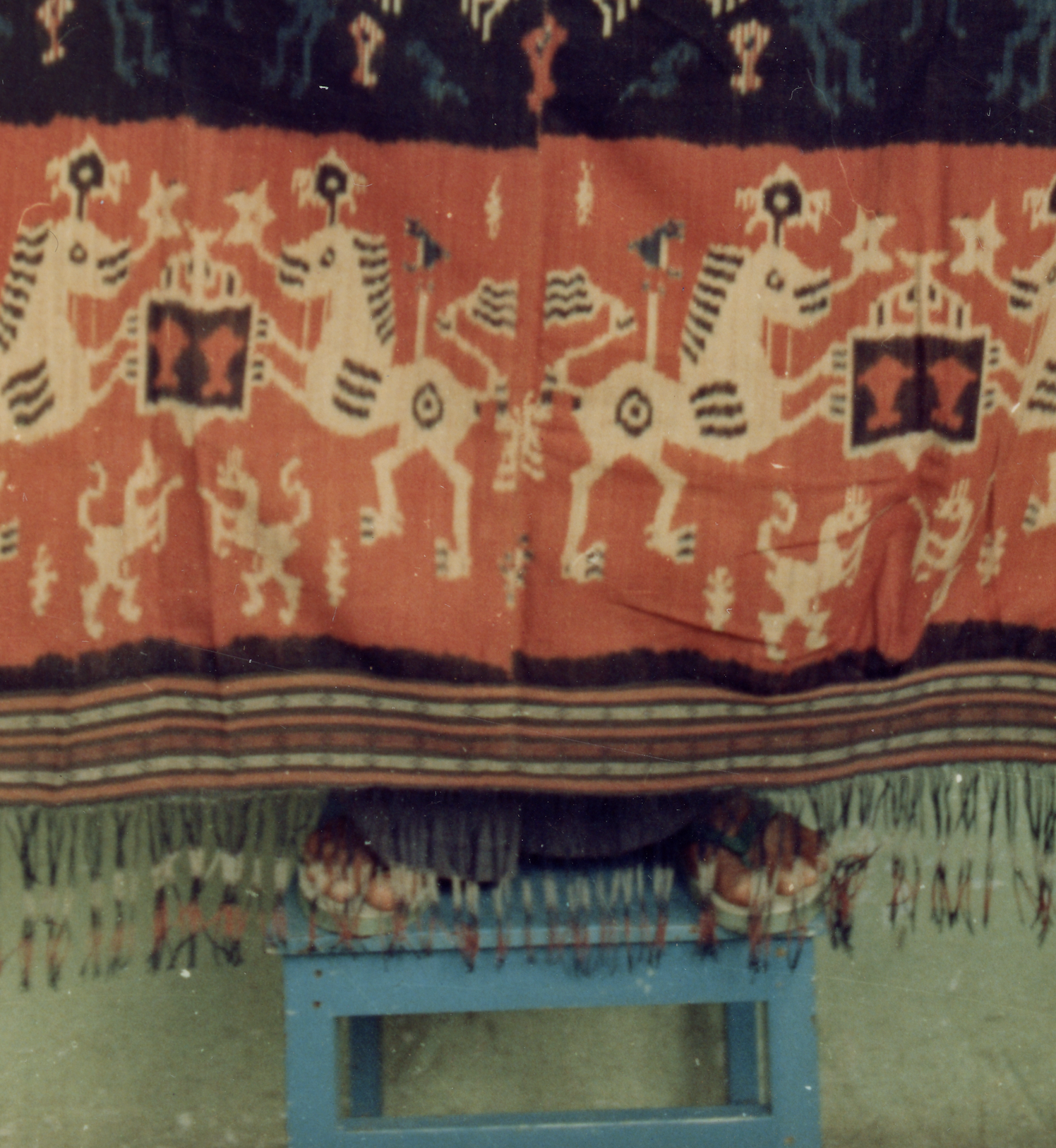
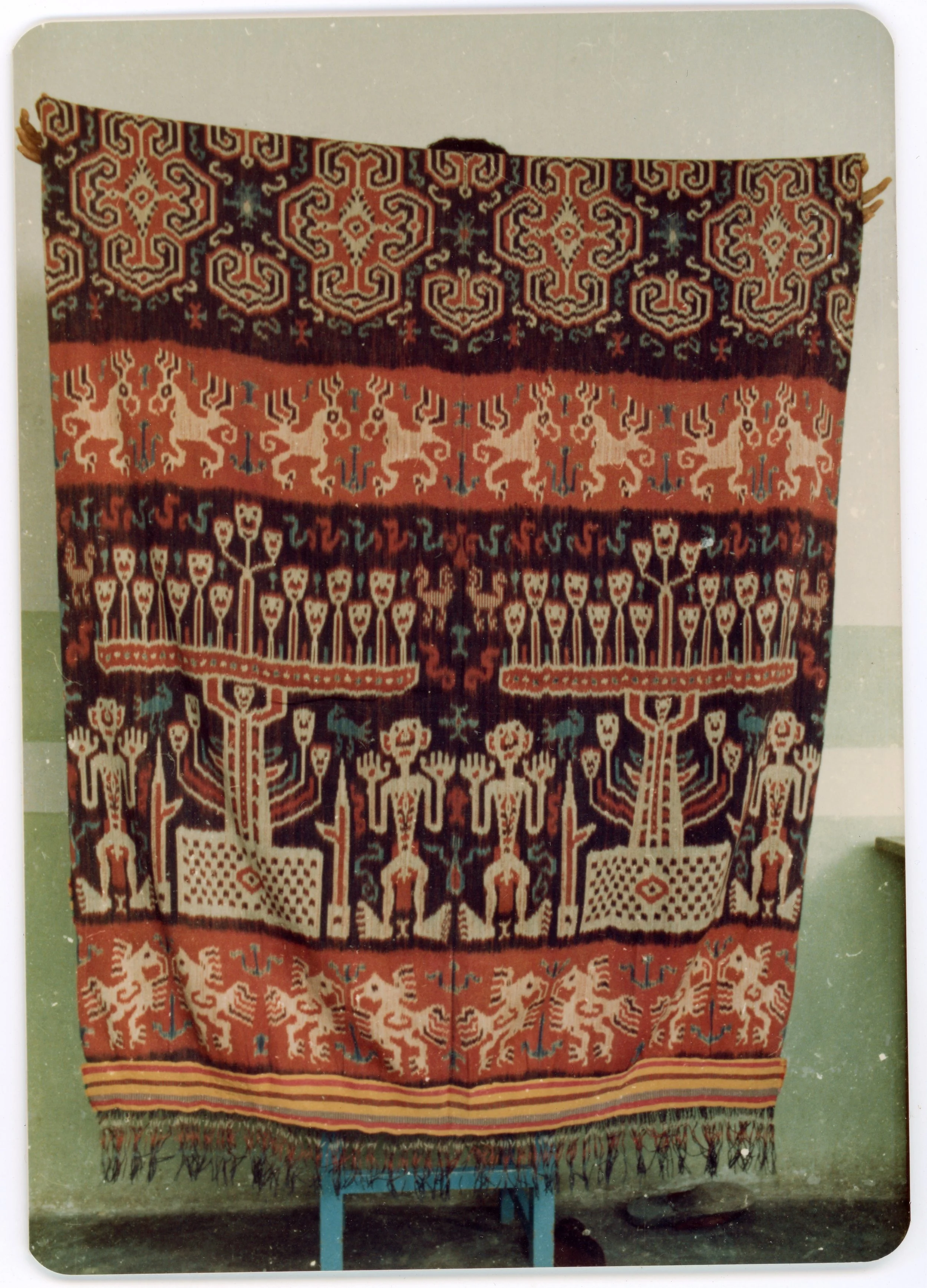
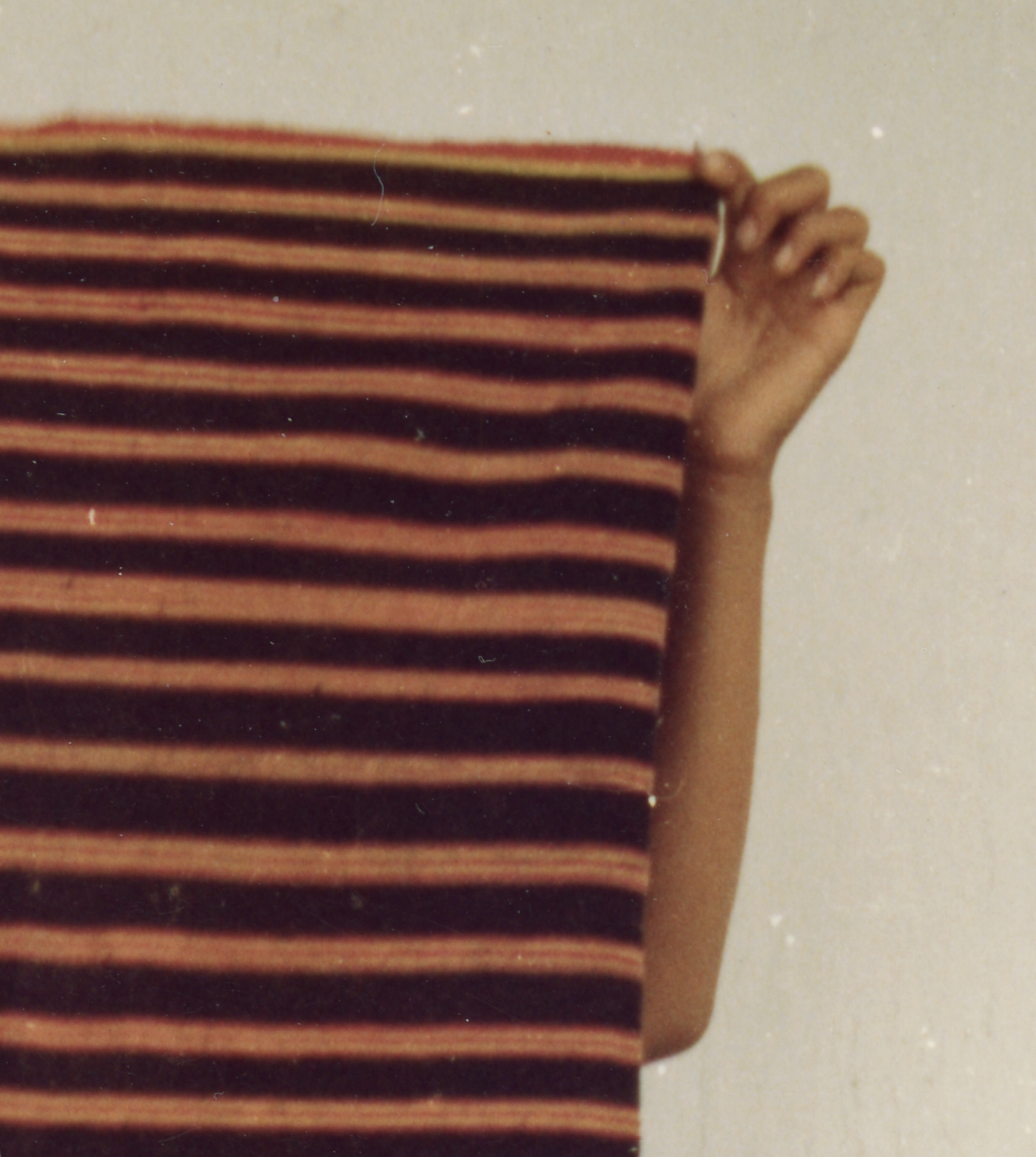
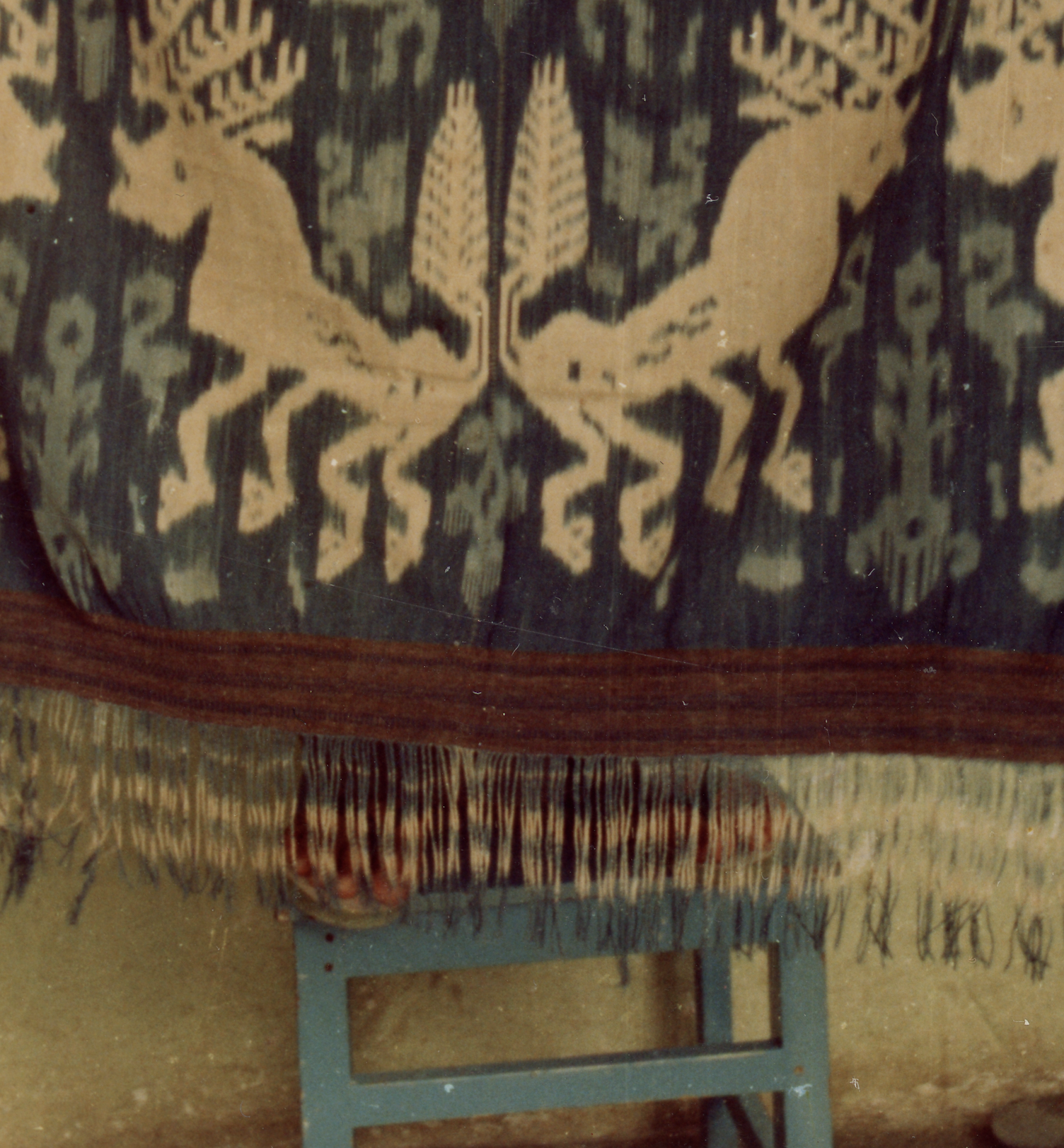
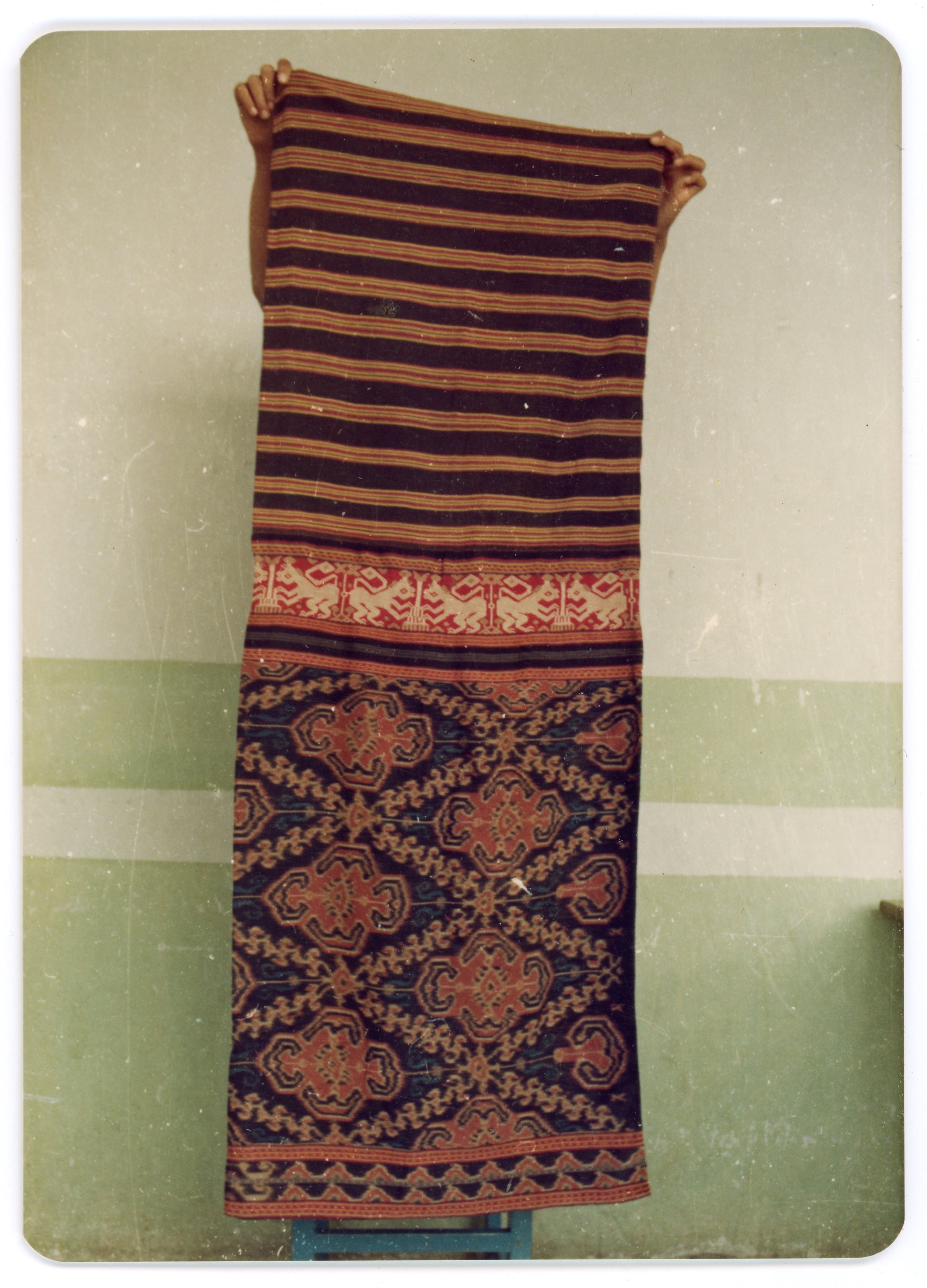
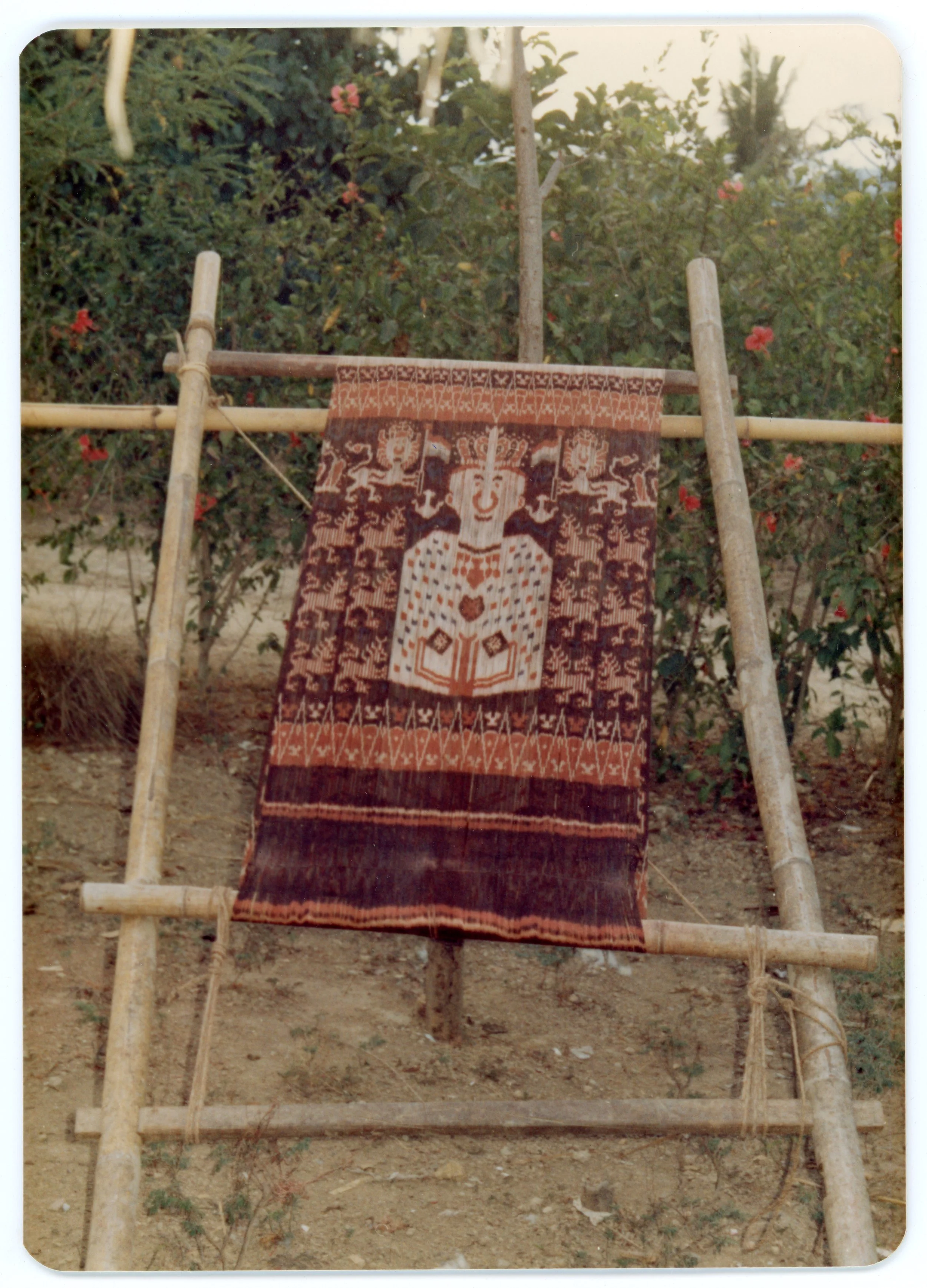
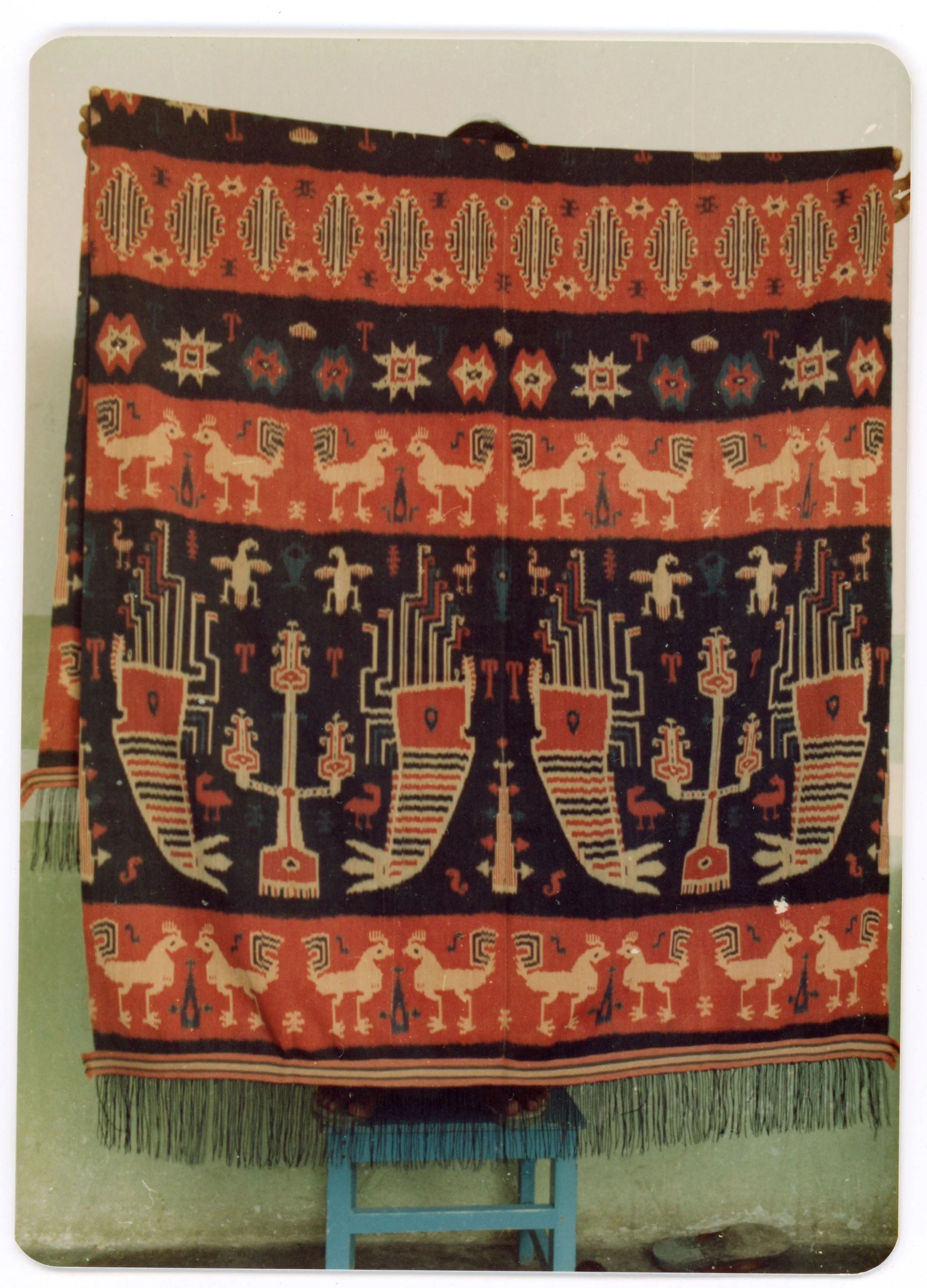
Associations with the divine become legible through photographs that register a particular form of cultural receptivity. The role of archaeology and ‘buried knowledge’ forewarned by another of Blunk’s chosen authors, Lucy R. Lippard, suggests in her dedicated essay Rooted, Excavated, Recreated that Blunk was not in isolation, although perhaps of a divergent personal register: “The notion of excavation, of hidden or secret objects, and of buried knowledge, has been a factor in much contemporary art (in the 1960s, for instance, minimalist Sol LeWitt made a series of boxes with undisclosed contents).” The body of photography associated with his travels provides an overture into reading East Sumbanese textiles through their chosen framing. Shown held at the sides by fingertips, faces non-exposed, with feet seemingly deciphered atop a blue-painted chair: the compositional logic, while striking, is repeatedly engineered. It becomes a technology of deciphering how the work gained value through its mere multiplicity. East Sumbanese Hinggi, men’s garments, are embedded with cosmological utterances such as skull-trees, serpentine bodies, roosters, and horses for spiritual protection and sustenance.
The role of skull-tree imagery, unique to East Sumba, and referenced extensively within the archive, foregrounds the relationship between Sumbanese headhunting practices and the natural world. Prior to Dutch colonialism's suppression of Sumba clan warfare (1904–11), headhunting was incorporated into the spiritual health of communities, with returning warriors placing trophy heads on cut trees, that would then fertilize the soil as a blood-offering. The denuding of skull-tree bark, once implanted in bare rock, represses any natural growth to revive. In the region of Inverness, California, where Blunk lived and worked, it is known that the logs he transformed were the Redwoods tossed by the sea on the beach, as Lippard had once noted – the ‘vital corpses’.
The imagery of skull-heads is also interwoven within female garments, lau, recognized by their definitive tubular structure and elaborate lower zone, many times surpassing the full length of the bodies holding them. The duality and mirror-effect of the symbols, evident in the layout of the composite mythological animals, encompass a system of legibility that oscillates between one another. The animation of the planar field once viewed in its totality, forms systems of relationships transcending natural elements such as the land, sea, and sky. This breathes into the human’s relationship to the worn garment, as it follows them from the vicinity of land to the ancestral realm beyond – with the orbit of transition sanctified by the act of weaving.
<> Photographs courtesy of The JB Blunk Estate, reproduced with permission. We extend our gratitude to Director Mariah Nielsen, Nora Boyd, and Gillian Sturtevant for their support in the creation of this feature. Original research into JB Blunk’s photographic archive, undertaken to identify the textiles depicted, was supported by the National Art Library at the Victoria and Albert Museum and informed by sources including Early Indonesian Textiles (The Metropolitan Museum of Art) and Textiles of Indonesia: The Thomas Murray Collection (Prestel). The fourth edition of JB Blunk, edited by Mariah Nielson and Kajsa Ståhl of Åbäke, also served as an important reference.
Original research and text © Katerina Papanikolopoulos for Athens Design Forum
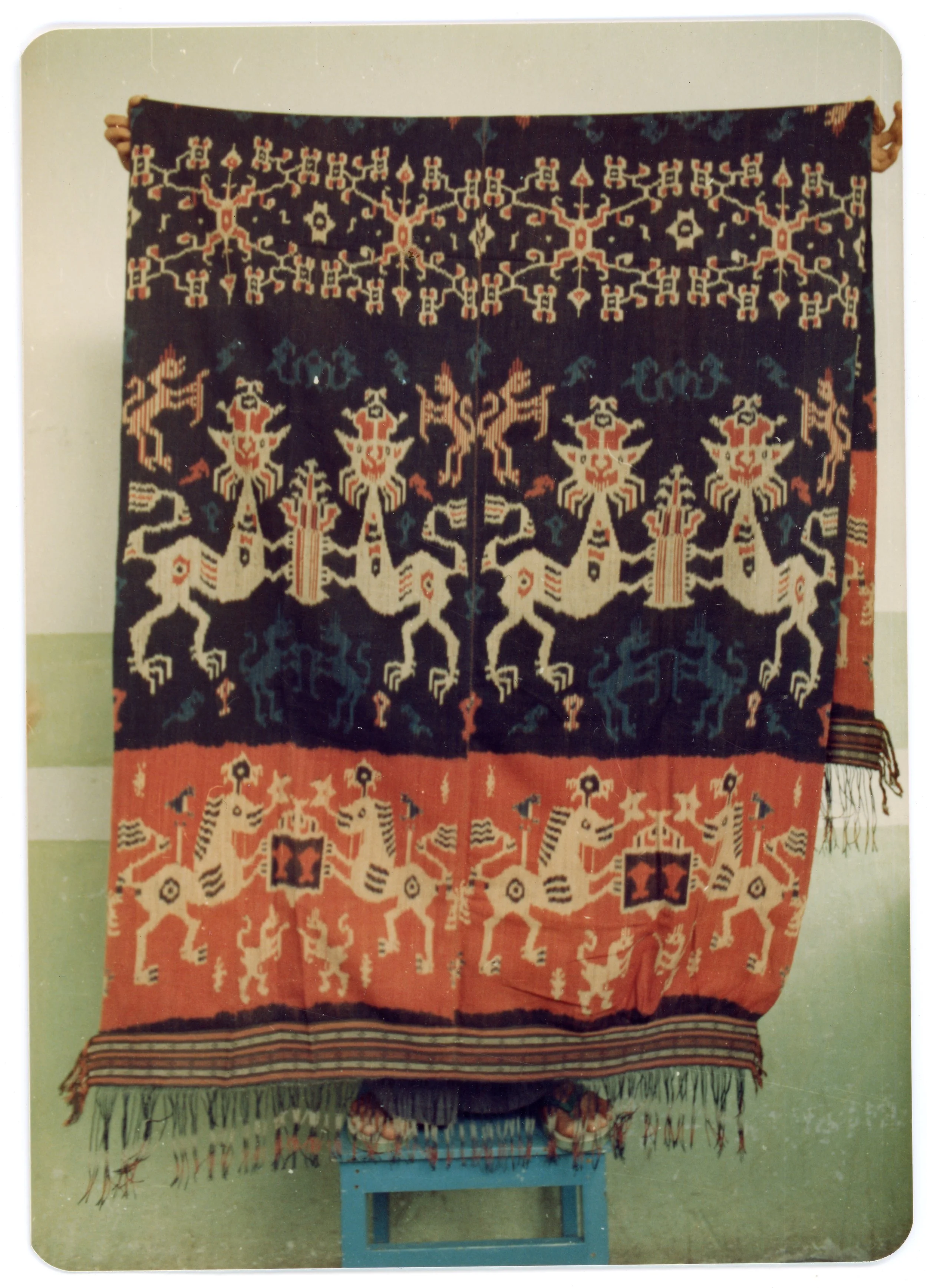
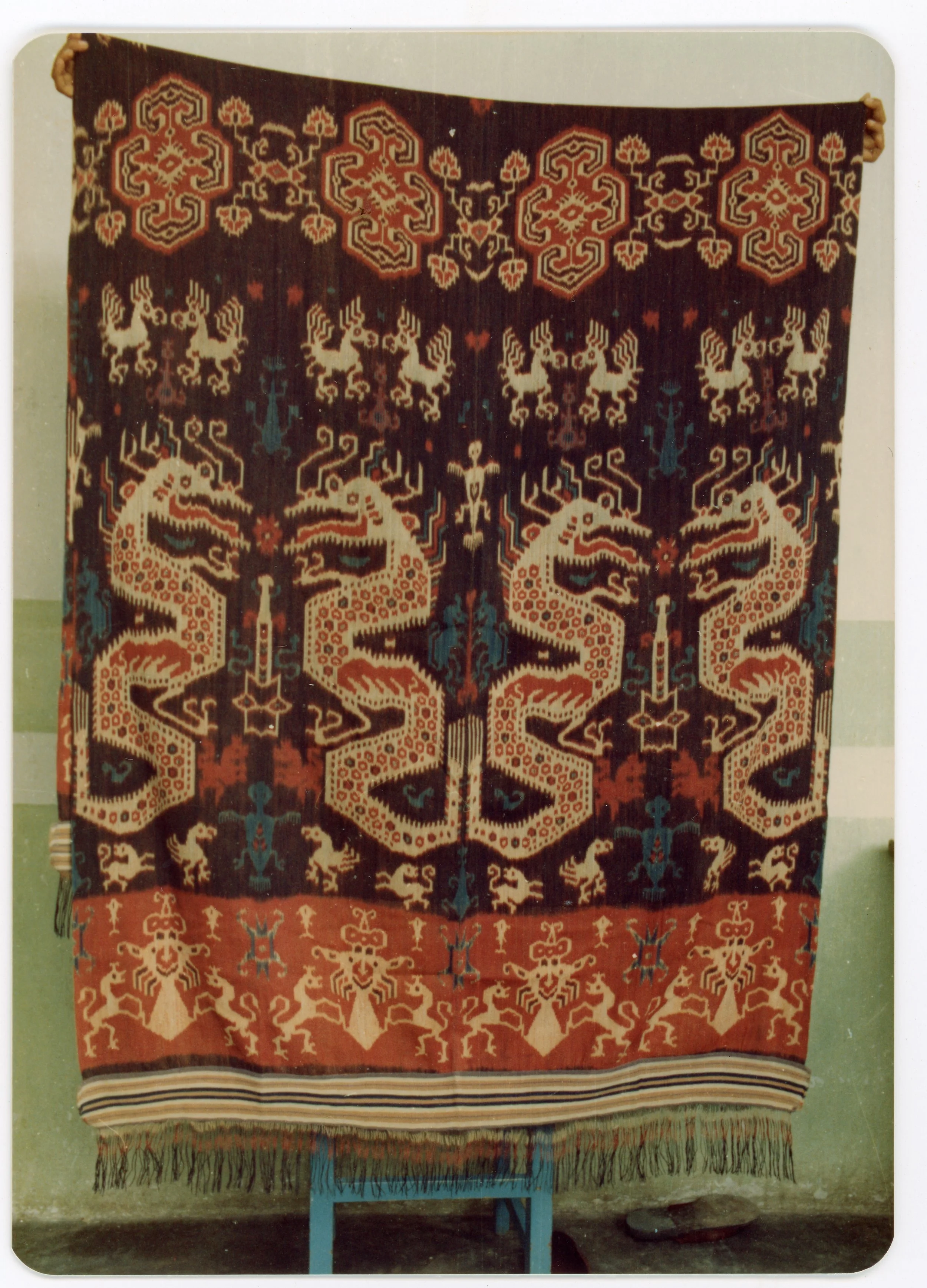
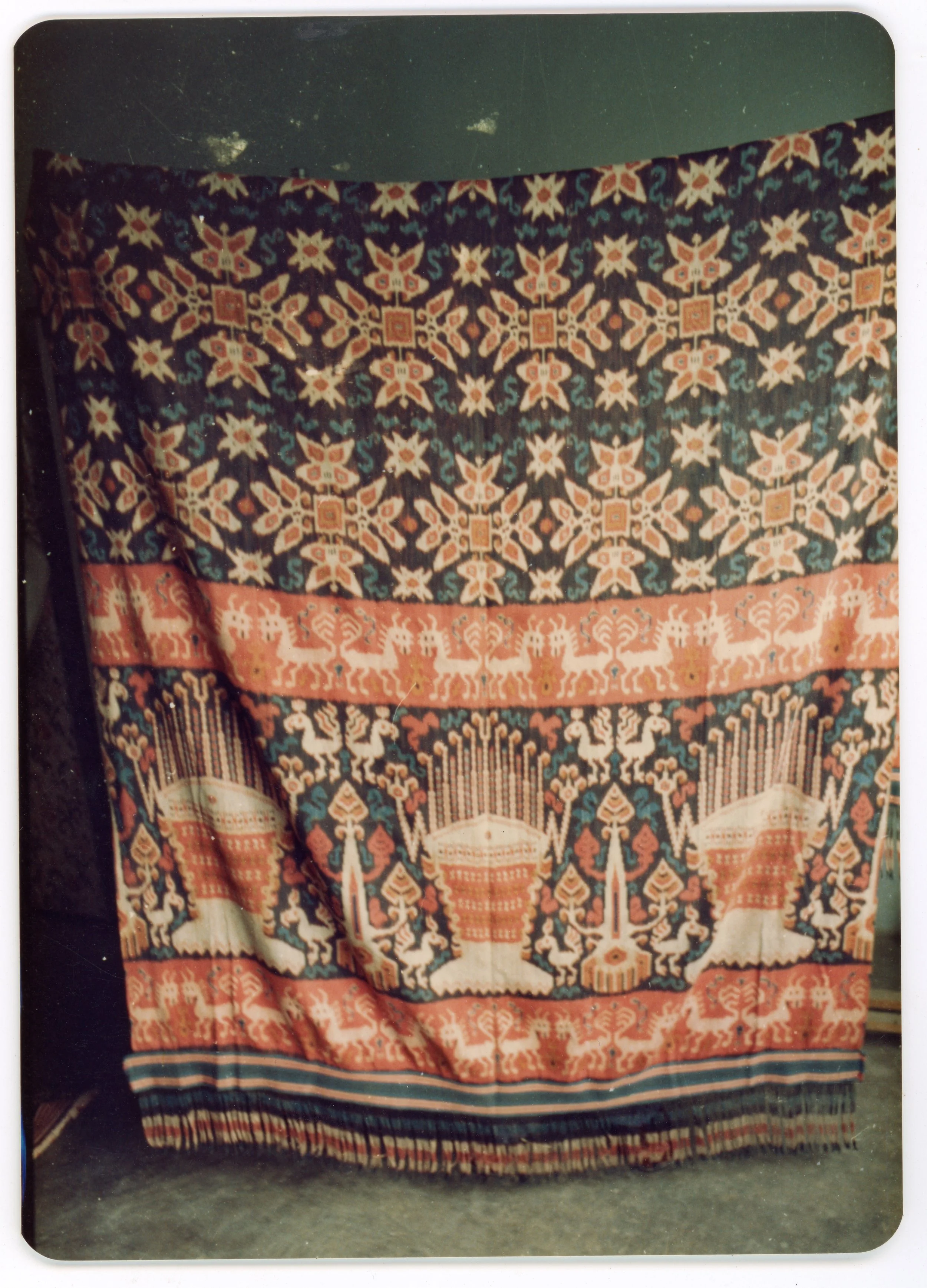
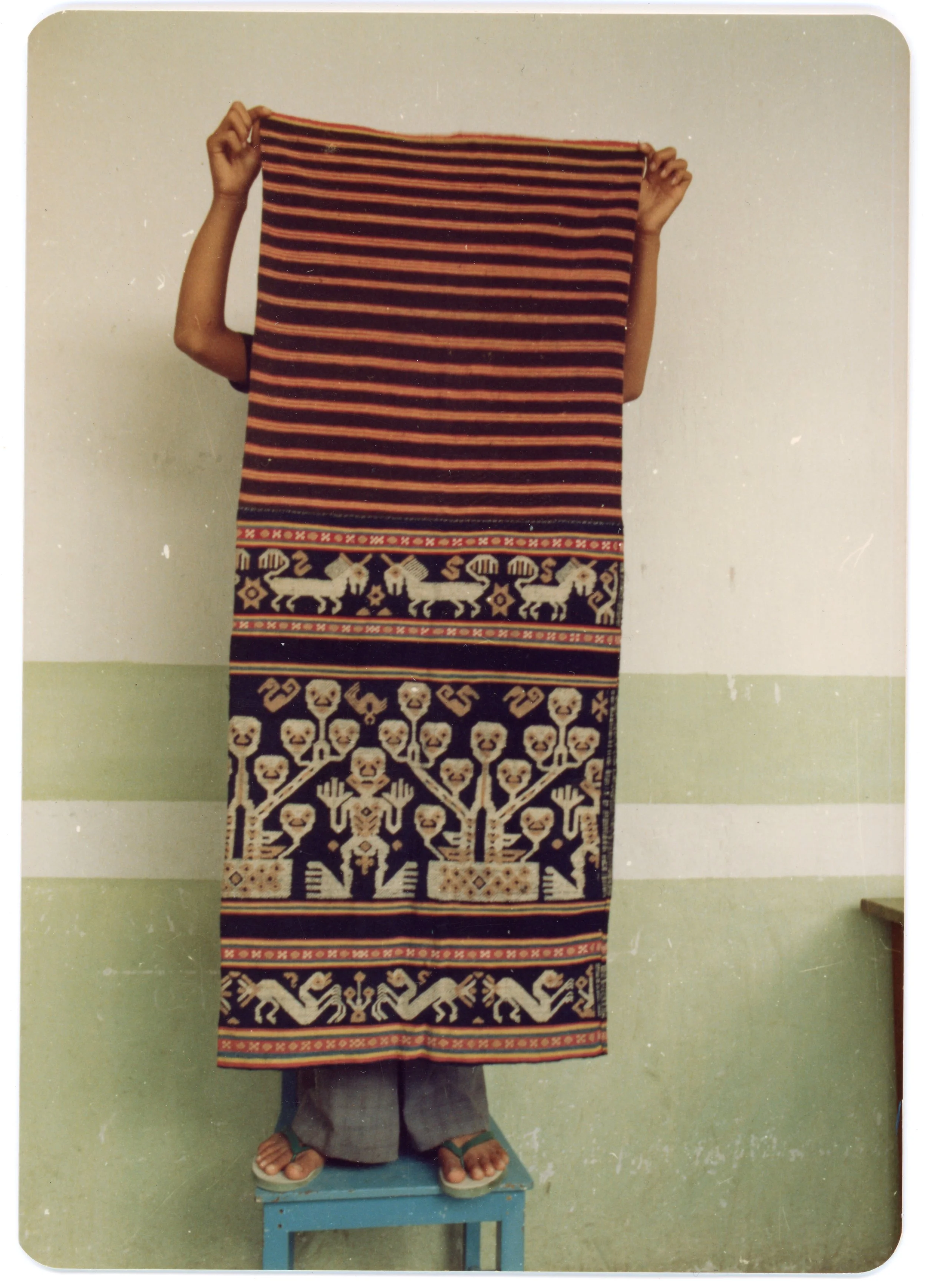
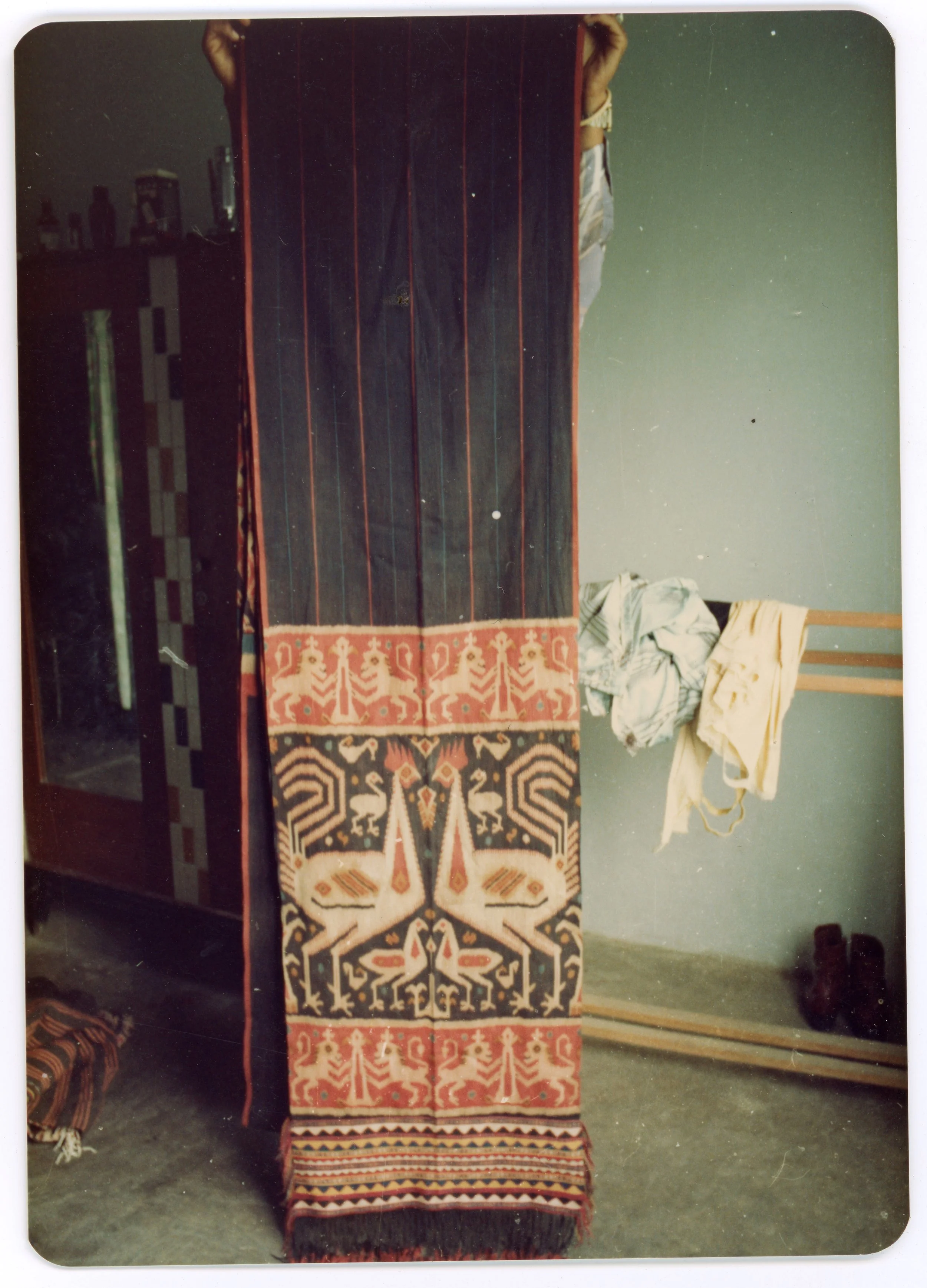
Within the act of reception lies the tension between recognition and the creation of new proportions, novel translations. As Ursula Le Guin contends in The Carrier Bag Theory of Fiction, an author within Blunk’s own personal library, “the first cultural device was probably a recipient.”
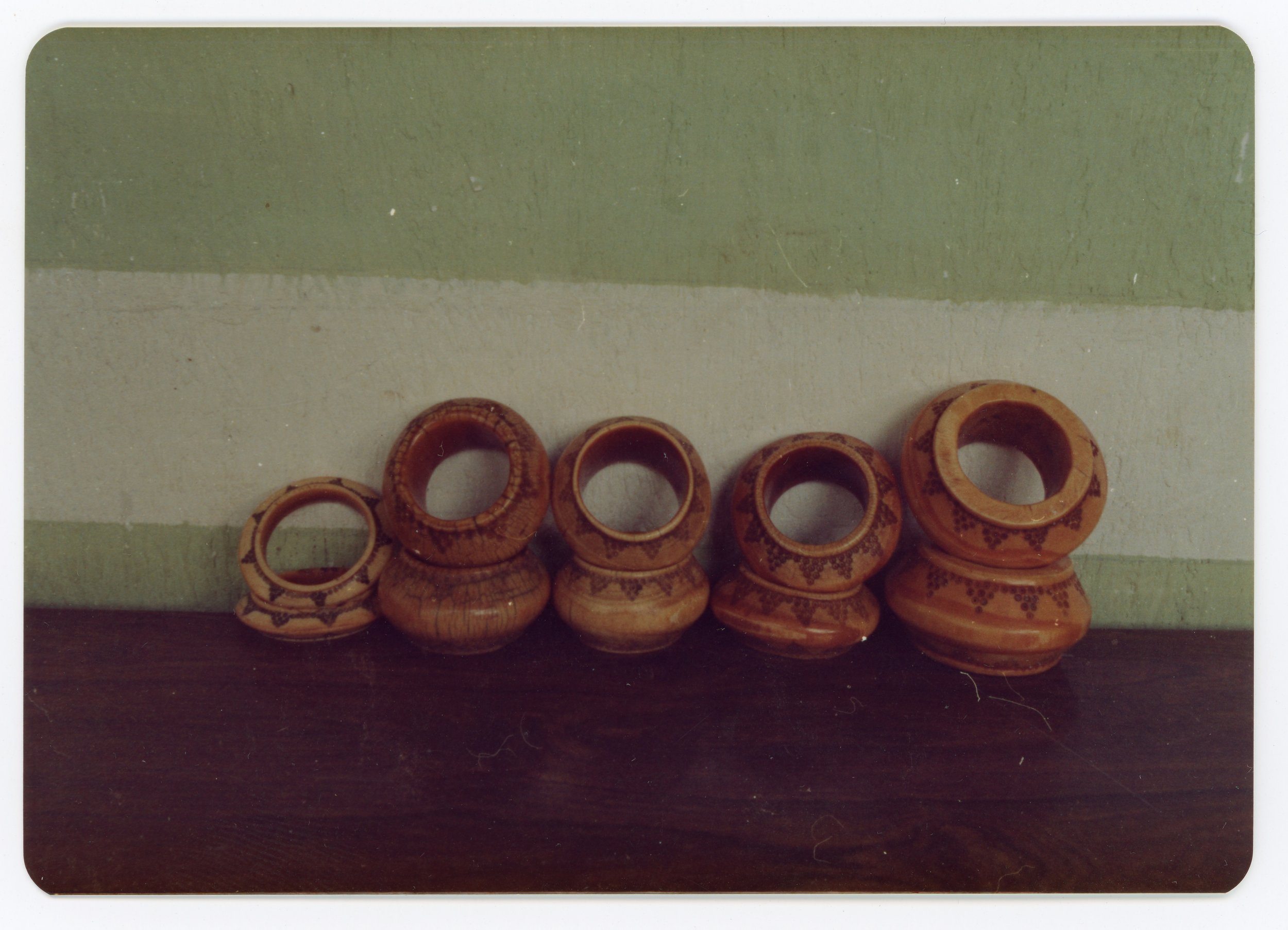
“A leaf a gourd a shell a net a bag a sling a sack a bottle a pot a box a container. A holder. A recipient”
– Ursula K. Le Guin, The Carrier Bag Theory of Fiction.
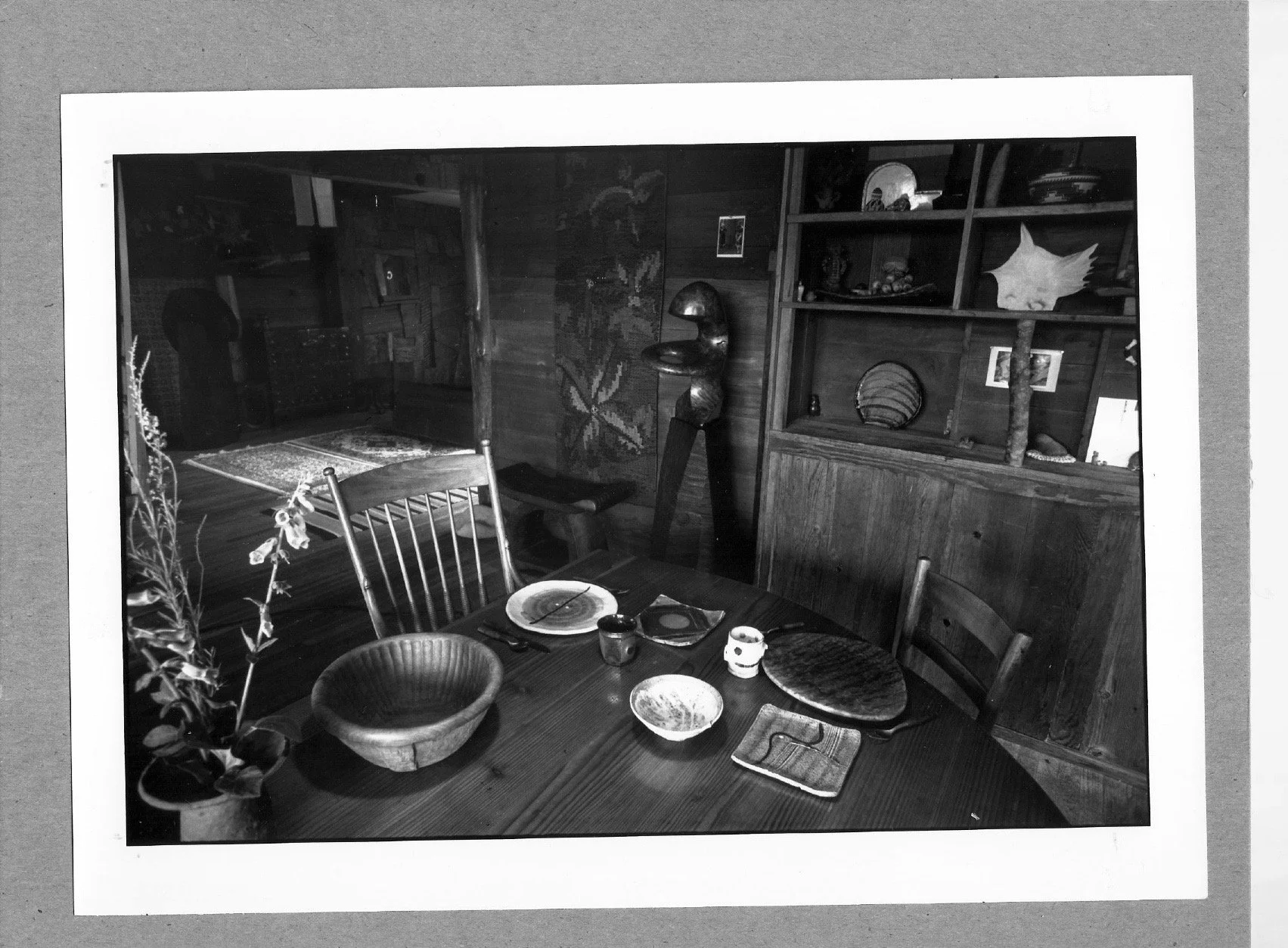
Gordon Ashby, Living room of JB Blunk’s house, c. 1985. Courtesy of The JB Blunk Estate.
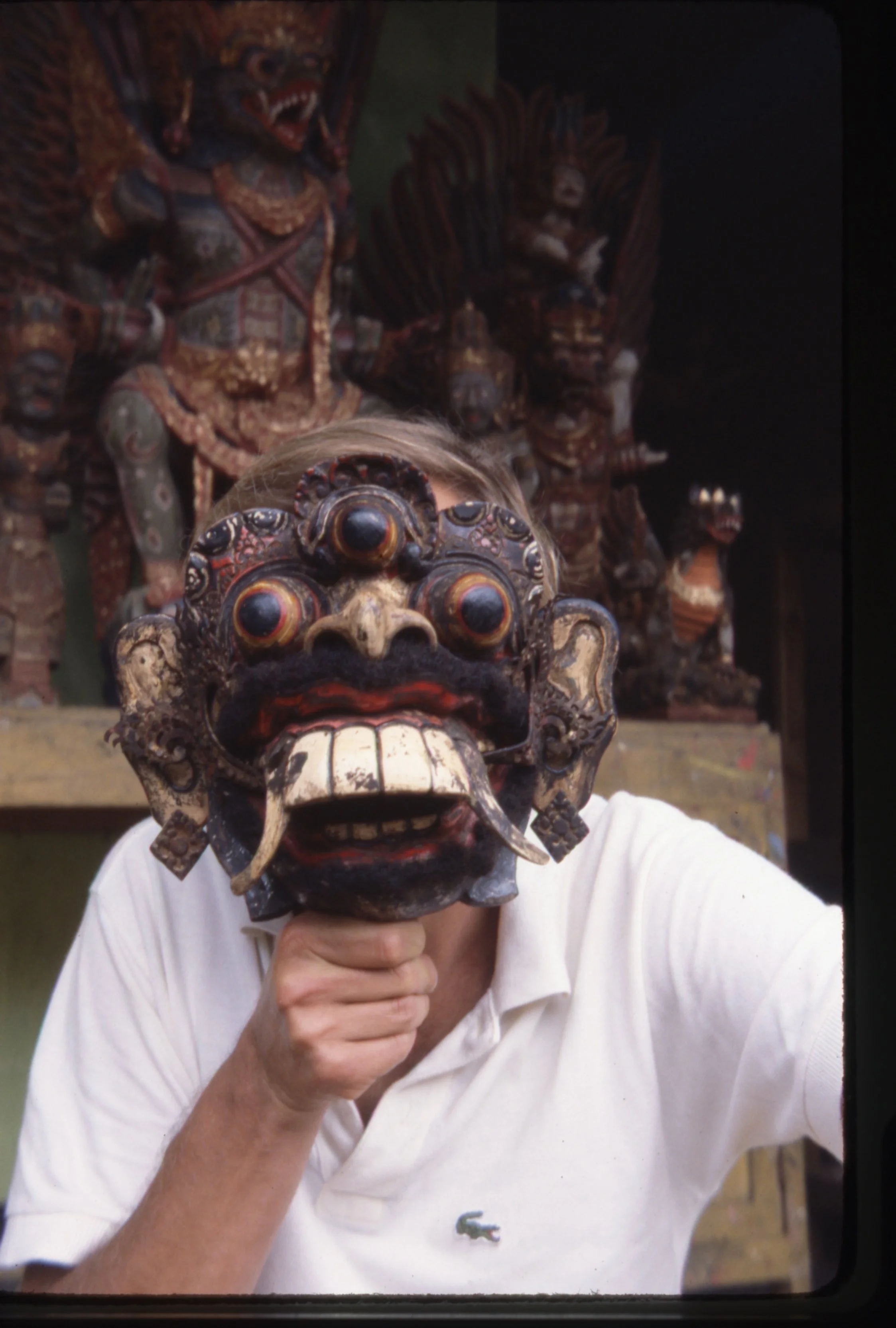
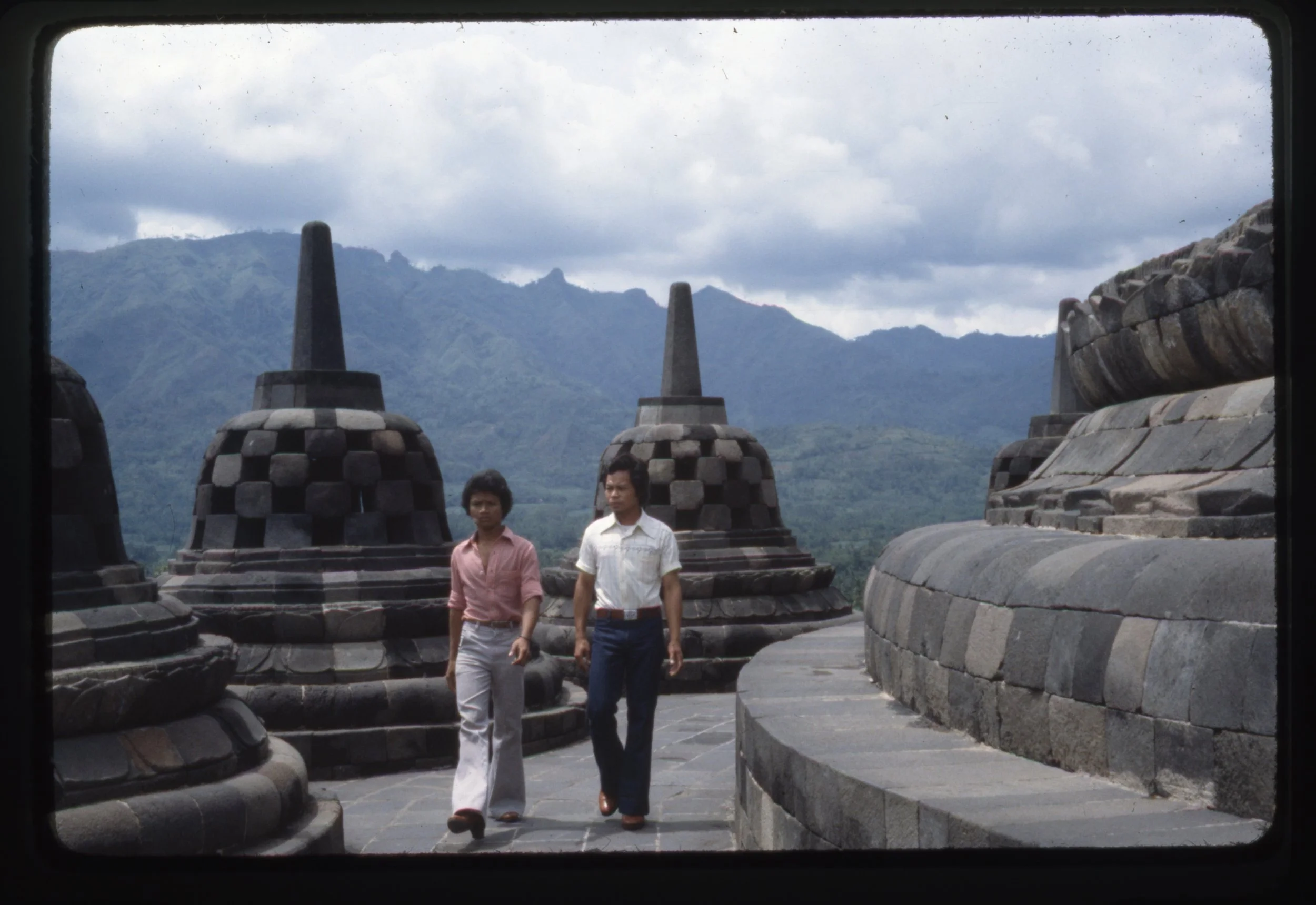
Additional imagery has been chosen to augment the collection of textiles: sacred sites with associated stone carving of phallic structures, boat and tree studies, and performative masks. Borobudur in Central Java is depicted with bell-shaped perforated stupas enveloped by volcanic mountains, conceived as a Buddhist pilgrimage through three realms.
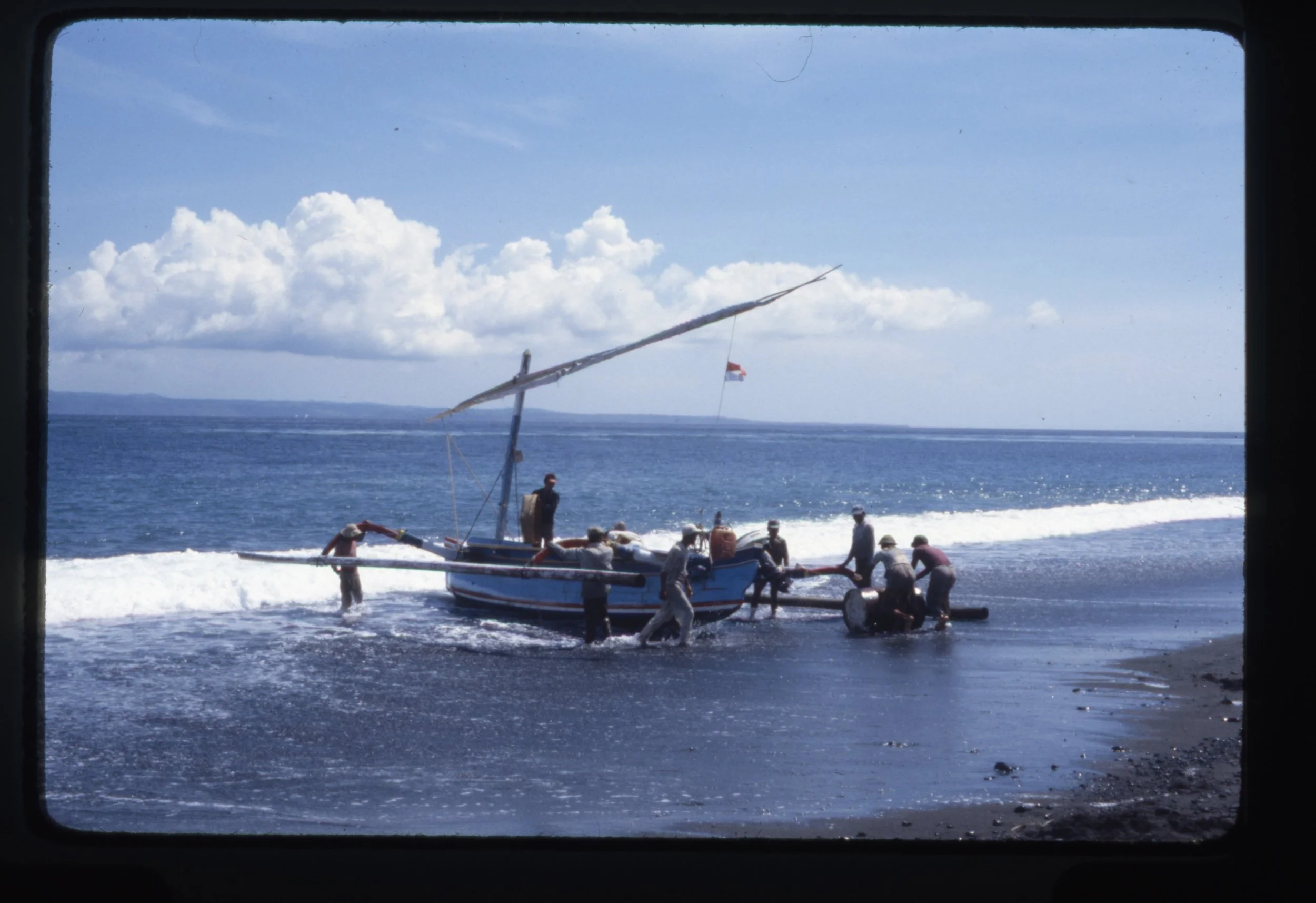
Images of the Balinese Jukung, an Indonesian canoe of curved bamboo/wooden connecting members, is distinguished by its upward-curving outrigger design used for fishing.
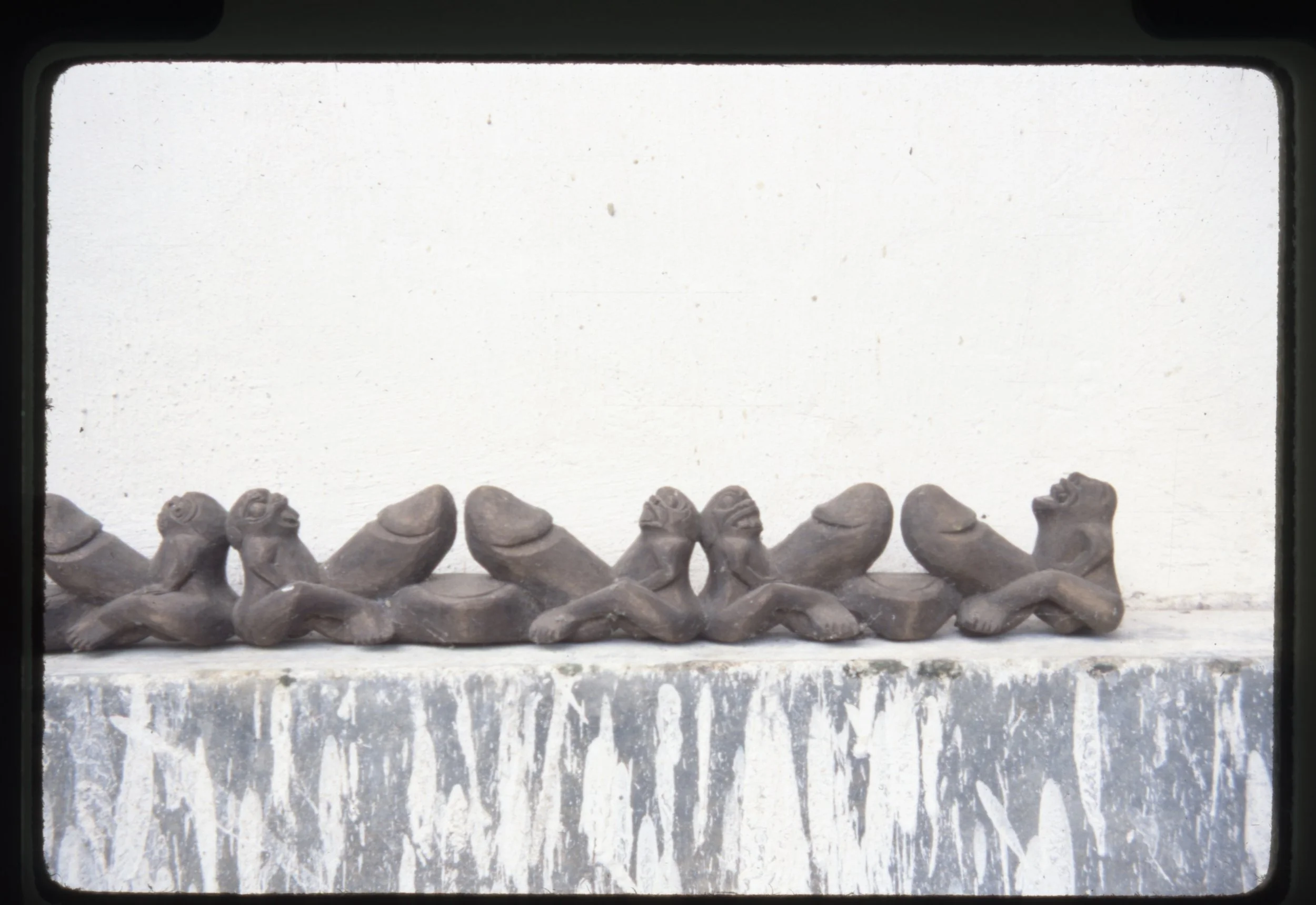
In an unidentified location in Indonesia, a procession of phallic stone sculptures evokes the lingga, a sacred form associated with creation, fertility, and the generative force of embodiment. It is a symbol that would be recurrent in his own work of the late 1970s, in creations such as the Redwood Penis Stool #1 (1975).
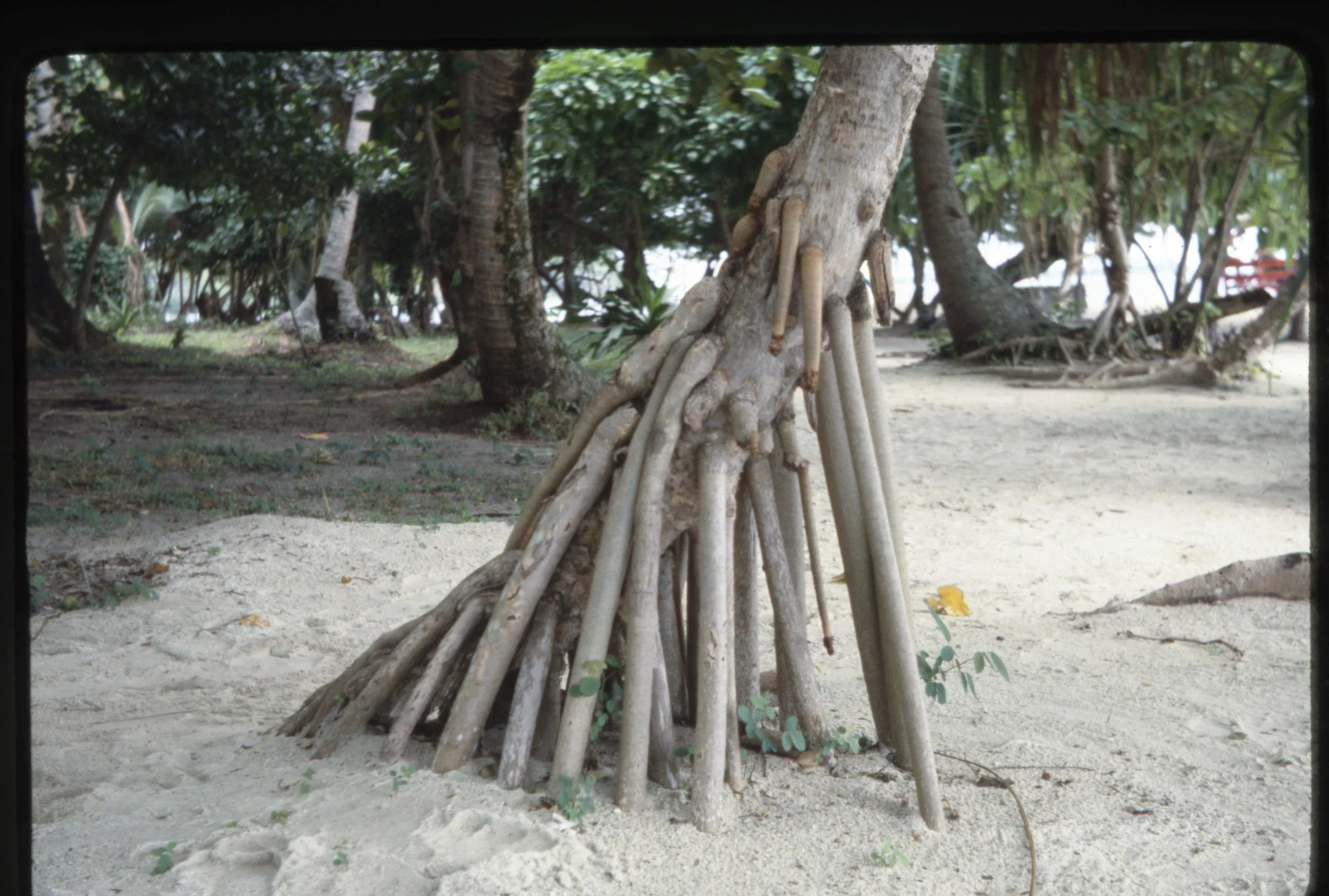
An introspection into a tree’s material properties is also made legible. The excessive growth of a tree’s roots by the sea, photographed in his collections, urges us to reconsider how his practice came to instruct associative gestures across territories.
-
The JB Blunk Estate preserves and advances the work of the late artist JB Blunk, through exhibitions and publications, and by maintaining the Blunk House, his iconic hand-built home in Inverness, California. The Estate incorporates Blunk Space, a gallery dedicated to contemporary artists and designers who are engaging with Blunk’s oeuvre and methods, in nearby Point Reyes Station, and Blunk Shop, which produces artisan-made reproductions of original objects made by Blunk.
-
Working primarily in wood and ceramic, artist James Blain Blunk (1926–2002) developed a distinct style that drew upon the Japanese principle of directness as well as an unfaltering reverence for the qualities of natural materials.
In the early 1950s, Blunk spent four formative years in Japan undertaking apprenticeships with master Japanese ceramicists Rosanjin Kitaoji and Kaneshige Toyo, who instructed him in the power of the elemental—earth, water, and fire—that would become fundamental to the character of his own work. He took these principles back to the US in 1954, eventually settling off the grid in Inverness, CA in 1958. There he built the Blunk House, a home and studio for his family using only salvaged materials, on an acre of land gifted from his friend and patron, the surrealist painter Gordon Onslow Ford. Having produced both the structure and contents of the home single-handedly, from the wooden furniture to the ceramics used daily for eating and drinking, Blunk considered it his masterpiece. In a conversation with Olivia H. Emery for her 1977 book Craftsmans Lifestyle, JB said: ‘I consider this whole place—house, studio, fruit trees, vegetable garden and chickens—one big sculpture.’
Throughout his career, he moved seamlessly between ceramics, jewelry, painting, weaving, furniture and sculpture, allowing the techniques of one medium to inform another. Blunk began working with wood in the 1960s, first making stools and small tables and eventually earning commissions for large-scale pieces and public sculptures.
His work has been exhibited widely, including retrospective exhibitions at the Martell Foundation, Cognac, France (2024) and the Oakland Museum of California, Oakland CA (2018); and a two-person show with sculptor Alma Allen at the Palm Springs Art Museum, Palm Springs, CA (2018). Blunk’s work is in public collections worldwide, including the Los Angeles County Museum of Art, Los Angeles, CA; M+ Museum, Hong Kong, China; Museum of Arts and Design, New York, NY; Oakland Museum of California, Oakland, CA; and the San Francisco Museum of Modern Art, San Francisco, CA, among others © The JB Blunk Estate
-
Founded by Katerina Papanikolopoulos in 2021, the non-profit Athens Design Forum (ADF) advocates for overlooked and generative design histories interwoven with global labor and migration patterns. Papanikolopoulos’ curatorial programming prioritizes photography and film as integral, critical methodologies to decipher design’s social role. Expanding into international dimensions from 2022, over thirty-five critical features and exhibitions have included collaborations with Museo Casa Mollino (The Skin of River Po), Rooms Studio (ROUTE-IN presented at Milan Design Week 2022), and an inaugural editorial feature of Archivo Gráfico™ (Venezuela) founded by Ricardo Báez. ADF’s ongoing film methodology investigates the work of Xhanfise Keko (Dropcity Center for Architecture and Design), Juan Pablo González, Marta Rodríguez & Jorge Silva, Izza Genini, and Hicham Gardaf—cementing their role as conduits to spatial and social discourse across geographies.
As featured in e-flux, Architectural Digest, Wallpaper*, DOMUS, and more.
On the occasion of the non-profit’s fourth anniversary in September 2025, Athens Design Forum announced the creation of Soil Epigraph, a private collection of anonymous photographs (1890-1980) foraged to exist in counterpoint to monolithic visual representations of Greece. (soilepigraph.org)
Athens Design Forum and Soil Epigraph are core projects led by the creative studio of Papanikolopoulos, MÁTI GREY. With a former training in dance and performance, Papanikolopoulos studied the intersection of Art History & Comparative Literature at the University of California, Los Angeles. She received her MA from the Architectural Association (History and Critical Thinking in Architecture). Prior to this, Papanikolopoulos builds on engagements with Blum & Poe, Autre Magazine, Assortment Agency, and The Hammer Museum.